The Portland Trail Blazers exceeded outside expectations during the 2025–26 NBA regular season, securing a 42–40 record and navigating the play-in tournament to reach the playoffs. A first-round exit against the San Antonio Spurs immediately shifted public focus from celebration to long-term sustainability. National basketball discourse quickly zeroed in on Deni Avdija, whose breakout campaign elevated him to individual stardom but also amplified the scrutiny surrounding his team’s long-term trajectory. Analysts began questioning whether the forward would be better served playing in a more traditional, stable environment rather than anchoring a volatile rebuilding project in the Pacific Northwest.
This line of questioning rests on a flawed premise regarding how the modern NBA collective bargaining agreement operates. Avdija did not actively choose to stay in Portland during the 2026 offseason through a fresh free-agency signing. The four-year, $55 million contract extension he originally signed with the Washington Wizards runs through the 2027–28 season, meaning the Trail Blazers control his services for two more full seasons. “Staying” in this context does not mean rejecting outside contract offers; instead, it indicates a conscious decision by the player and his representation to avoid forcing his way out. Avdija has refrained from scrubbing his social media, issuing trade demands through agents, or leaking discontent to national reporters. He has accepted his contractual reality and leaned into his role as a foundational piece of the franchise.
The real debate centers on whether Portland remains the optimal environment for Avdija to maximize his development now that he is an established All-Star. Players who jump from elite role players to franchise cornerstones require specific tactical infrastructure to sustain their efficiency. The Trail Blazers gave Avdija the developmental oxygen he needed, but their aggressive summer roster overhaul threatens to alter the exact conditions that permitted his rise. Evaluation of his situation must focus on developmental trajectory rather than transactional mechanics.
Remaining engaged with Portland was not an analytical error by Avdija, but the franchise’s recent personnel acquisitions create distinct operational hazards for him. The front office spent the summer adding high-usage, established ball-handlers to the roster. This influx of perimeter talent directly threatens the high-volume playmaking freedom that fueled Avdija’s statistical breakthrough over the past twelve months. He faces the distinct possibility of watching his offensive responsibilities shrink just as he enters his physical prime.
This analysis functions as an objective assessment of structural basketball fit rather than a generic seasonal preview. By examining what the Trail Blazers provided Avdija during his initial stint, we can pinpoint what the new-look roster might strip away from his offensive portfolio. Sustaining his All-Star trajectory requires specific tactical compromises from his teammates and coaching staff. The upcoming season will determine if Portland is a permanent home for a burgeoning star or merely a highly productive launching pad for his next destination.
Exhibit One: Portland Turned Avdija into an All-Star
Prior to his arrival in Portland, Avdija functioned primarily as a secondary connective piece within the Washington Wizards’ stagnant offensive systems. Capital city coaches used him as a standard floor-spacer, defensive stopper, and occasional transition pusher, capping his usage rate and limiting his self-creation opportunities. The trade to the Pacific Northwest fundamentally altered his career trajectory by removing these systemic shackles. Portland management viewed Avdija not as a complementary wing, but as a central offensive engine capable of carrying a structural burden.
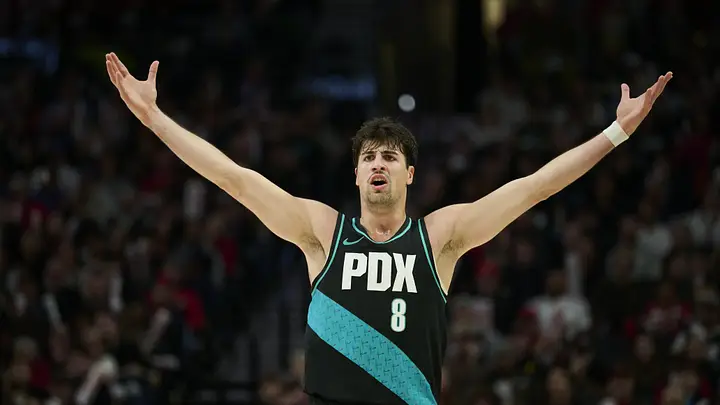
The analytical proof of this transformation sits in his baseline 2025–26 regular-season statistics. Avdija averaged 24.2 points, 6.9 rebounds, and 6.7 assists per game, numbers that firmly validated his selection to his first career All-Star game. This production did not result from empty statistics on a tanking roster, as Portland played meaningful, competitive basketball into late April. His usage rate climbed to a career-high 26.4 percent, reflecting a profound shift in how the coaching staff structured their half-court sets.
The 6.7 assists per game metric carries far more structural weight than his raw scoring increase. Portland’s coaching staff systematically converted Avdija into a point-forward, allowing him to initiate early offense, handle the ball in primary pick-and-roll actions, and dictate transition tempo. Instead of standing passively in the corner waiting for kick-out passes, he caught the ball on the move, directed traffic, and manipulated opposing low-man defenders. This playmaking responsibility unlocked his elite court vision, turning his size into a major passing advantage over smaller perimeter defenders.
Avdija paired this passing vision with a highly physical, downhill driving game that punished mismatched opponents. Standing 6-foot-9, he possessed the requisite strength to absorb contact in the lane, frequently drawing fouls against smaller wings who lacked the leverage to impede his path. He excelled at targeting slow-footed interior defenders on switches, using an improved handle to get to his spots in the painted area. This physical style translated to 7.4 free-throw attempts per game, providing Portland with a reliable source of efficient, clock-stopping offense.
Significant flaws still lingered within Avdija’s individual profile despite his massive statistical leaps. He shot a disappointing 31.8 percent from three-point range, allowing opposing defenses to go under screens and pack the paint during stagnant half-court possessions. His expanded playmaking role also brought a spike in turnovers, as he coughed up the ball 3.4 times per contest due to ambitious cross-court passing vectors. Elite defensive units exposed his occasional handling deceleration when forced to drive exclusively toward his left hand.
Portland’s 42–40 record, successful play-in campaign, and subsequent first-round postseason exit against San Antonio proved that Avdija’s production drove actual winning outcomes. Critics could not dismiss his numbers as empty calories accumulated on a cellar-dwelling team. The Trail Blazers played high-stakes basketball for four months, forcing Avdija to perform under intense scouting pressure. His production held steady during the playoff push, demonstrating that he could anchor a competitive NBA offense.
His performance during the first-round series against the Spurs highlighted the stark chasm between regular-season stardom and postseason leadership. San Antonio loaded up the paint, dared Avdija to beat them from the perimeter, and aggressively denied his favorite passing lanes. He struggled to generate clean looks in the half-court, seeing his scoring efficiency dip as the series progressed. This postseason resistance revealed that while he had evolved into an All-Star, he still required further technical refinement to dismantle playoff-caliber defensive game plans.
It is highly doubtful that any other NBA franchise would have granted Avdija the same combination of developmental patience, high usage, and organizational commitment. Had he been traded to an established contender, he likely would have remained cast in a specialized role as a defensive specialist and tertiary cutter. Portland provided the perfect vacuum of star power required for him to explore the absolute limits of his offensive toolkit. The franchise gave him the car keys, accepted his mistakes, and facilitated his rise to global recognition.
Exhibit Two: Portland’s Bold Summer May Help Him – or Crowd Him Out
The Portland front office rejected internal complacency during the 2026 offseason, aggressively reshaping the roster and coaching staff to accelerate their competitive timeline. Management hired Micah Nori as head coach, seeking his tactical adaptability and modern offensive design. The front office then executed a blockbuster trade to acquire superstar guard Ja Morant, while simultaneously preparing for the return of franchise icon Damian Lillard from a severe Achilles injury. To balance the ledger and create salary-cap compliance, the team parted ways with veteran forward Jerami Grant.
These dramatic transactions set up a projected starting lineup featuring Morant, Lillard, Avdija, Toumani Camara, and center Donovan Clingan. This configuration possesses immense baseline talent but presents a highly volatile mix of skill sets and developmental timelines. Nori must design an offensive system that satisfies multiple high-usage stars while maintaining the ball-movement principles that fueled their 2026 playoff run. The structural balance of this group will dictate whether Portland rises into the Western Conference elite or implodes due to internal friction.
The optimistic interpretation of this roster construction projects an easier operational environment for Avdija. Morant’s elite rim pressure forces opposing defenses to collapse into the paint, leaving massive gaps along the perimeter and secondary backline vectors. Lillard’s deep shooting gravity prevents opponents from helping off the top of the key, creating wide-open driving lanes for teammates. Avdija could thrive against compromised, rotating defenses, attacking closeouts, making quick interior passes, and scoring on baseline cuts without facing double-teams.
Avdija is perfectly built to operate as a high-level connecting player within this newly constructed star ecosystem. He can vacuum defensive rebounds, immediately push the pace in transition, and find Morant or Lillard running the wings for easy perimeter looks. His ability to short-roll out of secondary screening actions provides Nori with a crucial tactical counter when teams blitz his star point guards. In this role, Avdija does not need to carry the burden of creating advantages from scratch; he simply punishes defenses that have already shifted.
The pessimistic outlook suggests that Morant and Lillard will inevitably starve Avdija of the oxygen required to maintain his individual stardom. Both guards require high-volume time on the ball to maximize their effectiveness, which inherently reduces the number of possessions running through Avdija. The bench unit offers no relief, as young guard Scoot Henderson and the veteran Jrue Holiday require their own shares of playmaking opportunities. Avdija could quickly find his touches cut in half, reducing his role to that of an overqualified spectator for long stretches of play.
This structural shift risks pushing Avdija back toward the exact conventional forward role that limited his impact during his tenure in Washington. If Portland asks him to stand in the corner to maximize spacing for Morant pick-and-rolls, his structural value plummets. He lacks the elite, high-volume perimeter shooting touch to punish teams as a pure floor-spacer. Stripping him of his primary playmaking duties neutralizes his best attribute, rendering his individual talent underutilized within the team’s broader scheme.
Spacing constraints represent a critical vulnerability for this projected starting lineup. Morant has never developed into a reliable or willing long-range shooter, preferring to do his damage inside the paint. Avdija’s regression to 31.8 percent from deep means defenses will actively help off him to clog Morant’s driving lanes. With Clingan operating almost exclusively as a non-shooting, rim-running presence in the low post, the floor will look incredibly cramped. Teams will comfortably deploy zone defenses or heavy paint-packing schemes to choke out Portland’s internal driving vectors.
The defensive side of the floor presents an equally daunting challenge for Coach Nori. A backcourt pairing of Morant and an aging Lillard, who is returning from a catastrophic lower-leg injury, is highly vulnerable to point-of-attack penetration. Opposing guards will easily pierce the first line of defense, forcing Portland’s backline into constant help-and-recover emergencies. This structural deficiency places a massive defensive burden on the remaining three starters to clean up containment breakdowns.
Consequently, Camara and Clingan will be forced to cover multiple positions and defensive assignments simultaneously. Camara must take the toughest perimeter assignment every night, chasing elite guards and wings across screens to shield Lillard and Morant from physical mismatches. Clingan must anchor the paint as an elite rim protector, altering shots and erasing containment errors at the rim. If either defender gets into foul trouble or misses time with injuries, Portland’s defensive infrastructure will collapse completely.
Nori’s rotations must feature masterful tactical precision to mitigate these glaring systemic fit issues. He must stagger his star guards, ensuring that one of Morant or Lillard is on the floor with Avdija at all times to maximize playmaking balance. Nori needs to consciously construct lineups where Avdija serves as the clear primary creator while the star guards rest on the bench. He must also strictly avoid configurations that place too many non-shooters on the floor together, which would completely stall the half-court offense.
Avdija’s team-friendly contract adds a layer of transactional complexity to his standing within the organization. A versatile, All-Star point-forward earning an average of less than $14 million annually is one of the single most valuable assets in the entire league. While this contract protects Portland’s salary-cap flexibility, it also makes Avdija an incredibly attractive trade piece for a front office looking to make another major splash. If the Morant-Lillard experiment struggles early, management might feel tempted to package Avdija’s bargain contract to acquire an elite, high-volume perimeter shooter.
The Playoff Equation: Four Conditions Portland Must Meet
Portland’s pursuit of a top-six seed in the Western Conference cannot rely on general talent accumulation. The coaching staff must systematically answer four distinct operational questions during the regular-season calendar.
Test One: Health and Availability
The front office cannot construct its regular-season projection around the unrealistic assumption that its veteran stars will play 75 games each. Damian Lillard is entering his mid-30s and returning from an Achilles tendon rupture, an injury that historically saps lateral quickness and extends recovery timelines. Ja Morant’s high-flying, hyper-athletic style of play invites immense physical degradation, leading to frequent lower-extremity maintenance days. Portland must expect and plan for significant absences from its primary star backcourt throughout the grueling 82-game schedule.
The responsibility for maintaining regular-season stability falls squarely onto the younger, more durable trio of Avdija, Camara, and Clingan. Avdija must act as the team’s operational floor, stepping into primary scoring and playmaking roles on nights when Lillard or Morant sit out. Camara must provide consistent, elite perimeter defense without burning out from heavy structural usage. Clingan must provide dependable rim protection and rebounding to anchor the interior defense. If this young core cannot keep the team afloat during veteran absences, Portland will drop out of playoff contention before April.
Test Two: Enough Shooting to Open the Floor
Portland features a highly concentrated collection of rim-rebounding, downhill driving creators, but lacks an elite supply of high-volume perimeter floor-spacers. Opposing defensive coordinators will happily concede outside looks to Morant, Avdija, and Camara to wall off the paint. This defensive crowding directly harms Morant’s ability to explode to the rim and neutralizes Avdija’s physical, downhill driving game. If the floor remains persistently cramped, Portland’s individual offensive pieces will constantly get in each other’s way.
The current roster desperately needs an additional high-level asset: a dedicated movement shooter or a legitimate two-way forward who demands defensive attention beyond the arc. Without such a threat, Portland will struggle against disciplined defensive units that execute crisp help-and-recover schemes. If internal development from players like Avdija or Henderson fails to solve the spacing problem by January, General Manager Joe Cronin must look to the trade market. The front office will have to aggressively hunt for perimeter shooting upgrades, even if it requires surrendering draft capital or bench depth.
Test Three: A Workable Defensive Identity
The baseline infrastructure of Portland’s defense relies heavily on Camara’s elite perimeter isolation containment and Clingan’s interior rim protection. Camara possesses the lateral quickness to lock down elite point guards, while Clingan provides the size and instincts to alter shots at the rim. This combination gives Coach Nori a solid starting point for building a functional scheme. However, these two individual defenders cannot carry a defense if the rest of the unit fails to execute standard rotational assignments.
Protecting a small, defensively limited backcourt of Morant and Lillard requires intense, flawless help-and-recover discipline from the forwards. Avdija must balance his energy levels carefully, as he will be asked to defend elite Western Conference forwards while continuing to carry heavy offensive responsibilities. The team’s overall defensive success will ultimately hinge on transition defense and limiting live-ball turnovers. If Portland can stop opponent fast breaks and secure defensive rebounds, they can maintain a passable defensive rating.
Test Four: Surviving the Western Conference
The Western Conference remains an unforgiving gauntlet filled with elite, deeply established championship contenders and rising powerhouses. The Oklahoma City Thunder possess a historic collection of young talent, two-way depth, and draft assets. The San Antonio Spurs feature a generational superstar who completely alters the geometric calculus of the floor on both ends. Traditional contenders like Denver, Phoenix, and Dallas still possess MVP-caliber talents capable of winning any individual playoff series. Portland must navigate this brutal landscape without the benefit of an easy stretch in their schedule.
Analysis of Portland’s talent profile and structural risks yields three distinct regular-season outcomes:
- Best Case: Healthy veteran guards, improved spacing from Avdija, and an elite defense from Clingan lead to 47–50 wins and a top-six seed.
- Most Plausible Case: Occasional injury absences and expected spacing friction result in 43–46 wins, landing the team firmly in the play-in tournament.
- Failure Case: Severe injuries to Lillard or Morant, combined with a total defensive breakdown, leave Portland below 40 wins and outside the top ten.
Merely crawling back into the play-in tournament cannot be considered a successful outcome for this organization. The front office traded valuable assets and accelerated their timeline specifically to move past regular-season mediocrity. True progress for this franchise means securing an automatic playoff berth or winning a highly competitive first-round series against an elite opponent. If the Trail Blazers finish the season fighting for the ninth seed, their aggressive summer roster construction will have failed its initial test.
Closing Arguments: When Staying Becomes a Mistake
Deni Avdija did not make an analytical or professional error by remaining with the Portland Trail Blazers through the 2026 offseason. The franchise provided him with the developmental platform, high usage, and coaching confidence required to transform his career and become an All-Star. He plays on a highly favorable contract that protects him from immediate salary-cap pressure while enhancing his league-wide value. Furthermore, management proved its commitment to winning by aggressively adding elite talent over the summer to accelerate their competitive timeline.
This endorsement of his current situation comes with a major, clear qualification regarding his future usage under Coach Nori. Remaining in Portland will quickly turn into a mistake if the coaching staff strips the ball from his hands to accommodate the star guards. If Nori reduces Avdija to a standard floor-spacer whose main job is to cover for poor perimeter defenders, his talent will be wasted. Avdija cannot allow the franchise to use him as a financial band-aid or a trade chip while neglecting his development as a primary decision-maker.
The partnership between Avdija and the Trail Blazers must hit three distinct checkpoints during the 2026–27 season to justify its continuation. First, Avdija must maintain a significant playmaking role, ensuring his usage rate does not plummet alongside Morant and Lillard. Second, Portland needs to establish a clear winning record early in the season, proving they do not rely on a desperate late-season play-in chase. Third, the front office must show that its newly acquired veteran stars actively complement and elevate the team’s younger core.
Avdija will be completely justified in seeking an exit via a formal trade request if Portland fails to hit these vital benchmarks. If he finds his offensive role reduced to standing in the corner like a row of unused restaurant bar stools, his individual value will steadily erode. A persistent roster imbalance that leads to another early postseason exit without a clear plan for improvement should trigger a change in strategy. He has earned the right to play in an offensive system that maximizes his diverse, unique skill set.
The long-term outlook for Portland features an undeniable tension between high-end star talent and clean structural fit. The roster possesses more than enough raw ability to secure a playoff spot, but the pieces do not connect naturally. Nori faces an incredibly difficult task in balancing the needs of high-usage guards with the developmental trajectories of his versatile young forwards. Avdija’s decision should not be judged by whether Portland reaches the postseason, but by whether it reaches it with him still driving the team forward.