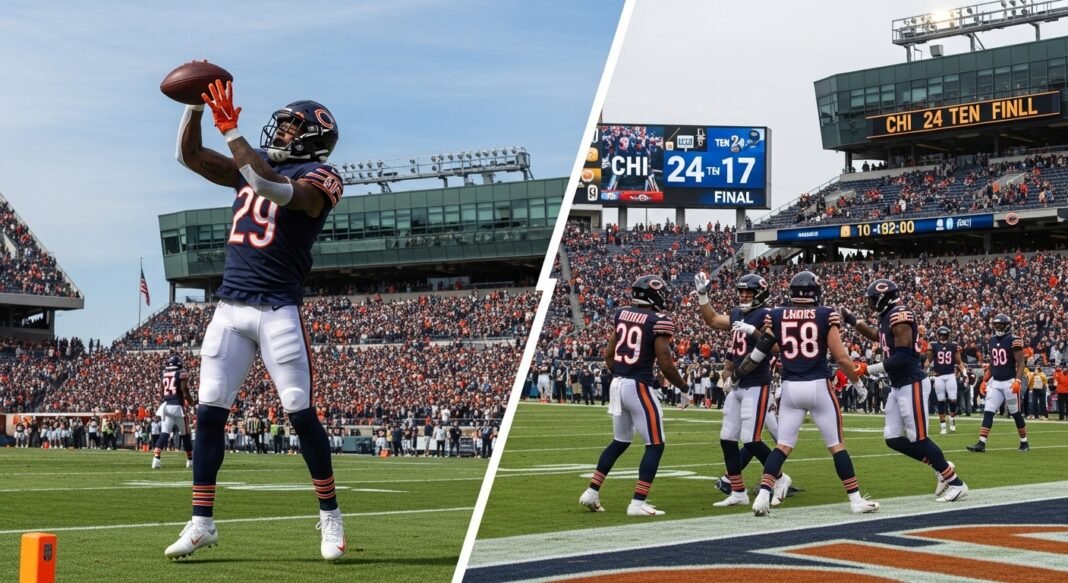
Chicago defeated Tennessee 24 to 17 at Soldier Field on September 8, 2024, in a game where the Bears offense failed to score a touchdown yet rallied from 17 points down. Tyrique Stevenson returned an interception 43 yards for a touchdown with 7:35 remaining, giving Chicago its first lead. Jonathan Owens scored on a 21 yard blocked punt return, while Cairo Santos converted three field goals. Darrell Taylor recorded two sacks in his Bears debut, and Will Levis threw two interceptions under heavy pressure from Chicago’s defensive front.
Table of Contents
Game Summary Stats
| Category | Tennessee Titans | Chicago Bears |
|---|---|---|
| Final Score | 17 | 24 |
| Total Yards | 244 | 148 |
| First Downs | 16 | 11 |
| Time of Possession | 34:54 | 25:06 |
| Turnovers | 3 | 1 |
| Third Down Efficiency | 3/14 (21%) | 2/13 (15%) |
| Fourth Down Efficiency | 1/2 (50%) | 2/2 (100%) |
| Penalties | 8 for 50 yards | 7 for 55 yards |
| Red Zone Efficiency | 1/2 (50%) | 0/1 (0%) |
Quarterback Performance
| Quarterback | Team | Comp/Att | Yards | TD | INT | Sacks | Rating | QBR |
|---|---|---|---|---|---|---|---|---|
| Will Levis | TEN | 19/32 | 127 | 1 | 2 | 3 for 23 yards | 52.5 | 31.0 |
| Caleb Williams | CHI | 14/29 | 93 | 0 | 0 | 2 for 29 yards | 55.7 | 22.5 |
Rushing Stats: Pollard Dominates Chicago’s Front Seven
| Player | Team | Carries | Yards | Average | TD | Long |
|---|---|---|---|---|---|---|
| Tony Pollard | TEN | 16 | 82 | 5.1 | 1 | 26 |
| Will Levis | TEN | 4 | 36 | 9.0 | 0 | 15 |
| D’Andre Swift | CHI | 10 | 30 | 3.0 | 0 | 20 |
| Caleb Williams | CHI | 5 | 15 | 3.0 | 0 | 11 |
| DJ Moore | CHI | 1 | 14 | 14.0 | 0 | 14 |
Receiving Leaders
| Player | Team | Receptions | Targets | Yards | Average | TD | Long |
|---|---|---|---|---|---|---|---|
| Calvin Ridley | TEN | 3 | 7 | 50 | 16.7 | 0 | 22 |
| DJ Moore | CHI | 5 | 8 | 36 | 7.2 | 0 | 13 |
| Keenan Allen | CHI | 4 | 11 | 29 | 7.3 | 0 | 9 |
| Tyler Boyd | TEN | 3 | 5 | 18 | 6.0 | 0 | 11 |
| Chigoziem Okonkwo | TEN | 2 | 2 | 15 | 7.5 | 1 | 17 |
Defensive Stats
Chicago Bears Defense
| Player | Position | Tackles | Solo | Sacks | TFL | INT | PD | FF |
|---|---|---|---|---|---|---|---|---|
| T.J. Edwards | LB | 15 | 10 | 0 | 2 | 0 | 0 | 0 |
| Jaquan Brisker | S | 9 | 5 | 0 | 0 | 0 | 0 | 0 |
| Darrell Taylor | DE | 8 | 7 | 2.0 | 2 | 0 | 0 | 1 |
| Gervon Dexter | DT | 4 | 2 | 1.0 | 1 | 0 | 0 | 0 |
| Tyrique Stevenson | CB | 4 | 2 | 0 | 0 | 1 | 2 | 0 |
| Jaylon Johnson | CB | 3 | 3 | 0 | 2 | 1 | 2 | 0 |
Tennessee Titans Defense
| Player | Position | Tackles | Solo | Sacks | TFL | INT | PD | FF |
|---|---|---|---|---|---|---|---|---|
| Amani Hooker | S | 6 | 5 | 0 | 0 | 0 | 2 | 1 |
| Harold Landry III | OLB | 6 | 3 | 1.0 | 1 | 0 | 0 | 0 |
| Kenneth Murray Jr. | LB | 6 | 3 | 0 | 0 | 0 | 0 | 0 |
| Roger McCreary | CB | 5 | 4 | 0 | 3 | 0 | 0 | 0 |
| Quandre Diggs | S | 4 | 3 | 0 | 0 | 0 | 0 | 0 |
Special Teams Performance
| Category | Tennessee | Chicago |
|---|---|---|
| Field Goals Made/Att | 1/1 (40 yards) | 3/3 (24, 48, 50 yards) |
| Extra Points Made/Att | 2/2 | 1/1 |
| Punt Average | 44.7 yards (6 punts) | 45.0 yards (6 punts) |
| Kick Return Average | 25.4 yards (5 returns) | 33.5 yards (2 returns) |
| Punt Return Average | 7.5 yards (4 returns) | 12.8 yards (5 returns) |
| Blocked Punts | 0 | 1 (TD return) |
How Chicago Won Without an Offensive Touchdown
This Week 1 game produced an unprecedented outcome. No team in NFL history had won after trailing by 17 or more points while gaining fewer than 150 total yards of offense. The Bears offense managed 148 yards and zero touchdowns. Their defense scored 14 points, special teams added seven, and Cairo Santos kicked three field goals.
Tennessee built a 17 to 0 lead through the first 26:16 of game time. The Titans outgained Chicago 179 to 51 in the first half. Tony Pollard capped an eight play, 79 yard opening drive with a 26 yard touchdown run at 0:41 of the first quarter. After Velus Jones Jr. fumbled the ensuing kickoff, recovered by Julius Chestnut at Chicago’s 23, Nick Folk kicked a 40 yard field goal.
The Titans extended their lead to 17 to 0 on a 14 play, 73 yard drive that consumed 8:23. Will Levis converted third and 15 with a 22 yard completion to Calvin Ridley, then found Tyler Boyd on fourth and three. Levis hit Chigoziem Okonkwo for a 17 yard touchdown with 3:44 left in the second quarter.
DeAndre Carter’s 67 yard kickoff return set up Santos’ 24 yard field goal with 27 seconds remaining in the half, cutting the deficit to 17 to 3.
The Special Teams Breakdown That Changed Everything
Daniel Hardy blocked Ryan Stonehouse’s punt at 9:07 of the third quarter. Jonathan Owens scooped the loose ball and returned it 21 yards for a touchdown. The play was Chicago’s first blocked punt in 189 games, a streak dating to 2012.
Hardy beat fullback Julius Chestnut off the edge on the play. The Bears had identified protection issues on Tennessee’s punt unit during film study and called the rush at the critical moment.
The momentum had shifted completely.
Santos hit from 50 yards early in the fourth quarter, making it 17 to 13. After Darrell Taylor’s strip sack gave Chicago possession at Tennessee’s 31, Santos connected from 48 yards. The Bears trailed 17 to 16 with 9:52 remaining.
Caleb Williams Makes History Despite Struggles
The first overall pick became the first quarterback selected first to win his debut start since David Carr in 2002. The 15 quarterbacks chosen first between Carr and Williams went 0-14-1 in their opening starts.
Williams completed 48.3% of his passes and averaged 3.2 yards per attempt. Chicago’s offense generated just 11 first downs and averaged 2.8 yards per play. The Bears converted two of 13 third downs and went 0 for 1 in the red zone.
His longest completion went 13 yards to DJ Moore. Williams took two sacks for 29 yards and scrambled five times for 15 yards. The Bears’ three top receivers combined for just 10 receptions and 76 yards on 23 targets.
The rookie showed poise in extending plays with his legs, buying time on five scrambles totaling 15 yards. His two point conversion pass to D’Andre Swift after Stevenson’s pick six provided the winning margin. Check our analysis of the Baltimore Ravens vs Pittsburgh Steelers match player stats to see how other young quarterbacks performed in Week 1.
Why Tennessee’s Coverage Scheme Failed Moore and Allen
Tennessee’s defensive coordinator came in with a clear plan. The Titans historically run zone coverage 71.1% of the time, primarily deploying Cover 2 looks to keep everything in front. DJ Moore entered the game as the second most productive receiver against Cover 2 in 2023, accumulating 273 yards against that specific scheme.
The matchup should have favored Chicago. Instead, Moore finished with just five catches for 36 yards. Keenan Allen, who typically thrives finding soft spots in zone coverage, caught four passes for 29 yards on 11 targets.
The issue was Williams’ inability to deliver the ball accurately to his weapons. On targets to Moore and Allen, Williams completed just nine of 19 attempts. Tennessee’s secondary, led by L’Jarius Sneed and Roger McCreary, played disciplined zone technique and rallied quickly to the catch point. The Titans limited Chicago to 13 yards on their longest completion, preventing any explosive plays downfield.
Levis Collapses Under Relentless Pressure
Tennessee’s second year quarterback faced pressure on 47.4% of his dropbacks, the second highest rate of any Week 1 starter according to Next Gen Stats. When pressured, Levis completed just four of 11 passes and threw both interceptions.
Chicago’s pass rush dominated in the second half. Taylor beat his man repeatedly off the edge. Gervon Dexter collapsed the pocket from the interior. The combination forced Levis into rushed decisions and erratic throws.
His catastrophic mistake came with 7:35 left. As DeMarcus Walker closed in for a sack, Levis flipped the ball toward Boyd in desperation. Stevenson read the throw, intercepted it at Tennessee’s 43, and returned it untouched for the go ahead touchdown. Williams hit Swift for the two point conversion, giving Chicago a 24 to 17 lead.
Game over.
Levis later called the play a “bonehead” decision. Jaylon Johnson sealed the victory with an interception at Chicago’s 40 with 1:05 remaining. For more on how Tennessee’s passing game evolved through the season, see our Tennessee Titans vs Detroit Lions match player stats breakdown.
Ground Game Battle: Pollard Thrives, Swift Struggles
Pollard’s debut with Tennessee validated the team’s decision to replace Derrick Henry. His 16 carries produced 82 yards at 5.1 per attempt. On the opening touchdown drive, Pollard rushed six times for 54 yards, including a 26 yard touchdown where he cut back against pursuit and outran Chicago’s secondary.
Pollard ran behind Tennessee’s zone blocking scheme, reading defensive end crashes and cutting back when Chicago’s linebackers pursued too aggressively to the play side. His patience allowed him to find running lanes as blockers reached the second level. He added three catches for 12 yards in the passing game. Tennessee rushed 26 times for 140 yards at 5.4 per carry. Levis contributed 36 yards on four scrambles. find running lanes as blockers reached the second level. He added three catches for 12 yards in the passing game. Tennessee rushed 26 times for 140 yards at 5.4 per carry. Levis contributed 36 yards on four scrambles.
Swift managed just 30 yards on 10 carries for Chicago. Tennessee’s defensive line, anchored by Jeffery Simmons and T’Vondre Sweat, won at the point of attack. The Titans’ front seven penetrated Chicago’s interior gaps, forcing Swift to bounce runs outside where linebackers Kenneth Murray Jr. and Harold Landry III closed pursuit lanes.
Chicago ran just 53 offensive plays compared to Tennessee’s 61, limiting their opportunities to establish drives. The Bears’ inability to sustain possessions meant their defense spent extended time on the field, particularly in the first half when Tennessee possessed the ball for long, clock consuming drives.
Ridley’s 50 Yards Lead All Receivers in Low Scoring Affair
Ridley led Tennessee with three catches for 50 yards on seven targets. His 22 yard reception on third and 15 extended Tennessee’s second scoring drive. Boyd caught three passes for 18 yards, including the critical fourth down conversion. Okonkwo’s 17 yard touchdown reception came on second and eight from Chicago’s 17, where he went up over coverage in the end zone.
Tennessee targeted receivers 32 times, completing 19 for 127 yards. Tyjae Spears caught four passes for 11 yards out of the backfield, often providing short outlet options when Levis faced pressure.
Moore’s five receptions for 36 yards on eight targets topped Chicago’s receiving corps. Allen saw 11 targets but caught just four for 29 yards, as Williams’ inaccuracy on intermediate routes limited production. Rome Odunze, the ninth overall pick, caught one pass for 11 yards but fumbled after the reception, though Teven Jenkins recovered at Tennessee’s 10.
Chicago’s Defensive Adjustments Shut Down Tennessee
The Bears held Tennessee scoreless after the Titans scored at 3:44 of the second quarter. Chicago’s defense generated three fourth quarter takeaways that directly produced 17 points.
Taylor, acquired from Seattle on August 24, recorded two sacks and the momentum shifting strip sack in his Chicago debut. Pro Football Focus graded Taylor at 78.6 for the game. His speed off the edge consistently beat Tennessee’s tackles, forcing Levis to rush his progressions.
Johnson earned a 92.3 PFF grade, the highest among all defenders in the game. He faced three targets in coverage, allowing one completion for negative two yards. His fourth down interception with 1:05 left ended Tennessee’s final possession.
T.J. Edwards totaled 15 tackles with 10 solo stops and recovered Taylor’s forced fumble. Brisker made nine stops from the safety position, often coming downhill to stuff runs.
The Bears recorded three sacks and eight tackles for loss. Chicago’s defensive line tightened their gaps in the second half, taking away the cutback lanes that Pollard exploited early. The adjustment forced Tennessee into predictable play calling on obvious passing downs.
Tennessee’s Defense Holds Bears to Historic Low Output
The Titans held Chicago to 148 total yards and zero offensive touchdowns. They allowed just 64 net passing yards and 84 rushing yards. The Bears averaged 2.8 yards per play and converted two of 13 third downs.
Harold Landry III was active all afternoon, totaling six tackles with a sack and tackle for loss. Sebastian Joseph-Day disrupted Chicago’s run game with three tackles, one sack, and two tackles for loss at the line of scrimmage. Roger McCreary shot gaps aggressively, finishing with five tackles including three stops behind the line.
Kenneth Murray Jr. and Amani Hooker combined for 12 tackles between them. The Titans recorded two sacks and eight tackles for loss. Tennessee’s defense forced five punts and limited Chicago to three scoring drives, all ending in field goals. Pro Football Reference’s advanced metrics show Tennessee’s defense allowed an expected points added of just negative 12.59 for Chicago’s offense.
Three offensive turnovers and a blocked punt negated this performance.
Santos and Carter Deliver in Crucial Moments
Chicago’s kicker converted all three field goal attempts: 24 yards in the second quarter, 50 yards early in the fourth, and 48 yards with 9:52 remaining. His accuracy maintained Chicago’s comeback hopes when their offense stalled repeatedly. Santos has made 14 field goals of 50 or more yards as a Bear, third most in franchise history behind Robbie Gould (23) and Kevin Butler (16).
Carter accumulated 131 return yards, consistently providing favorable field position. His five punt returns averaged 12.8 yards, including returns of 20 and 16 yards that shifted momentum after Chicago punts. His 67 yard kickoff return in the second quarter gave Chicago possession at Tennessee’s 34, leading to Santos’ 24 yard field goal just before halftime.
Historic Comeback: Bears Match Stats Enter Record Books
Chicago became the third team in the Super Bowl era to win after scoring zero touchdowns and trailing by 17 or more points. The 2006 Bears defeated Arizona in a similar fashion. Kansas City beat Carolina in 2016 under the same circumstances.
The rally from 17 down matched Chicago’s largest comeback since the 2020 season opener in Detroit. The Bears erased a 23 to 6 fourth quarter deficit to win 27 to 23. This comeback ranks as the fourth largest in franchise history.
Brian Callahan’s debut as Tennessee’s head coach ended in frustrating fashion. His team dominated statistically but couldn’t finish. Callahan acknowledged after the game that “we just handed them points” on turnovers and special teams mistakes.
Matt Eberflus’ Bears won their seventh straight home game dating to 2023, the team’s longest home streak since 2008 and 2009. The streak includes victories over playoff contenders and division rivals. For more Week 1 results and player performances across the NFC North, see our Detroit Lions vs New York Giants match player stats analysis.
Final Analysis
Chicago’s 24 to 17 victory proved that defensive and special teams execution can override yardage advantages. Tennessee outgained Chicago 244 to 148 and controlled possession by nearly 10 minutes, yet three fourth quarter turnovers and a blocked punt return decided the outcome.
The game’s key plays will feature prominently in Week 1 highlight reels as examples of how defensive moments define games.
Williams became the first top overall pick to win his debut start in over two decades despite completing less than half his passes. Levis built a 17 point lead before collapsing under relentless fourth quarter pressure. Player stats from this September 8 matchup illustrate how turnovers and special teams execution determine winners when offenses struggle.