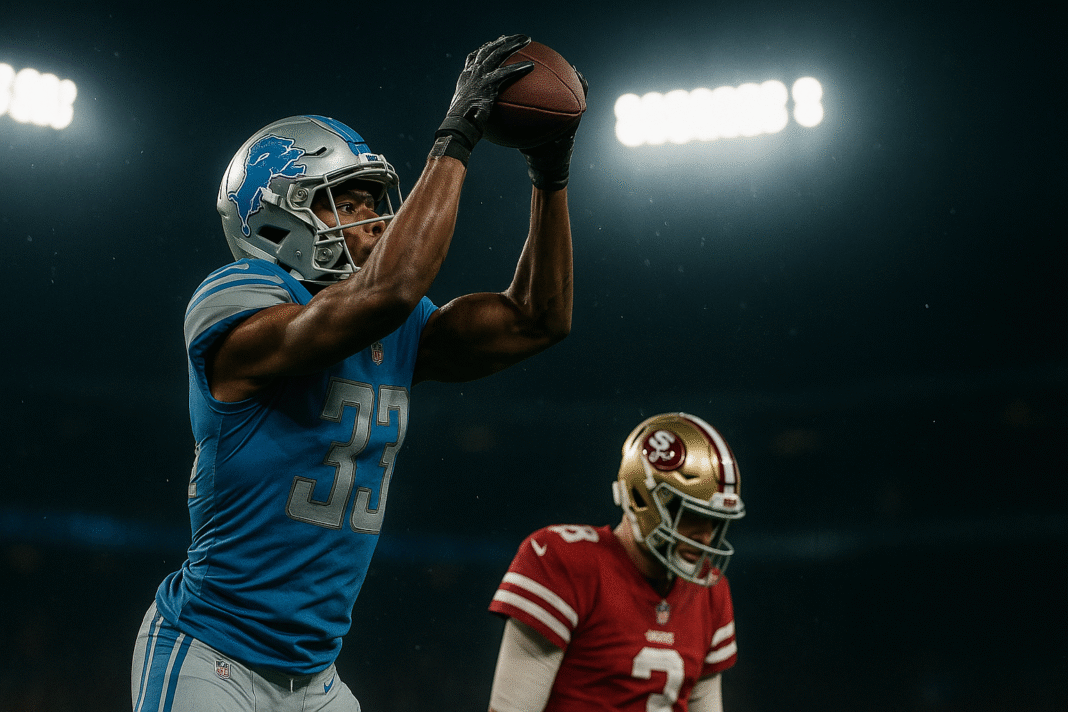
Detroit Lions vs San Francisco 49ers match player stats: Lions 40, 49ers 34 on December 30, 2024. Jahmyr Gibbs ran for 117 yards and the clinching touchdown. Jared Goff threw three scores without turning the ball over. Kerby Joseph picked off Brock Purdy twice, both directly leading to Detroit touchdowns.
San Francisco put up 475 total yards. Didn’t matter.
Ricky Pearsall caught eight passes for 141 yards in his breakout performance. George Kittle added 112 yards to hit 1,000 for the season. But Purdy’s two interceptions wiped out everything positive. Detroit improved to 14-2 heading into their Week 18 clash with Minnesota for the division title and number one seed. The 49ers ended their home schedule at 6-10, already eliminated from playoff contention.
This Monday Night Football revenge game at Levi’s Stadium closed the book on the previous season’s NFC Championship heartbreak. Eleven months earlier, Detroit blew a 17-point halftime lead in this same building. This time, they protected a second-half lead by doing what they failed to do last January: zero turnovers. San Francisco threw two picks. Football’s simplest equation.
Table of Contents
Quarterback Performance: Protection vs Production
| Quarterback | Team | Comp/Att | Yards | TD | INT | Sacks | Rating |
|---|---|---|---|---|---|---|---|
| Jared Goff | DET | 26/34 | 303 | 3 | 0 | 2 | 132.4 |
| Brock Purdy | SF | 27/35 | 377 | 3 | 2 | 2 | 116.0 |
| Joshua Dobbs | SF | 3/4 | 35 | 0 | 0 | 0 | 101.0 |
Goff’s zero in the interception column won this game.
He completed 76.5% of his passes with three touchdowns, checking every box Detroit needed from their quarterback. Advanced metrics showed 8.9 yards per attempt with consistent accuracy underneath and over the middle. He took two sacks but never risked the football. Extended his streak to four straight games with at least three touchdown passes as the playoffs approached.
Purdy threw for 74 more yards and matched Goff’s touchdown total. But those two picks destroyed San Francisco’s chances. Both happened in the second half with the game hanging by a thread.
The first interception, an overthrow to Pearsall late in the third quarter, gifted Detroit possession at the 49ers’ 43-yard line. Detroit scored on the ensuing drive to take their first lead.
The second pick arrived with 7:30 left in the fourth. Purdy forced another throw over the middle. Joseph read it and jumped the route. Gibbs scored his 30-yard touchdown run on the next possession to make it 40-28.
Here’s the damning part: both interceptions happened identically. Detroit showed single-high safety pre-snap, then rotated to inverted Cover 2 after the snap. Joseph sat in the middle zone waiting for Purdy’s predetermined read. The quarterback threw to his pre-snap option without processing the post-snap rotation. When Joseph jumped the first one, any competent quarterback adjusts at halftime. Purdy threw the same interception twice against the same coverage concept.
Three straight games with game-changing interceptions. If you’re San Francisco’s front office, how do you commit $60 million per year to a quarterback who can’t read coverages under pressure?
Dobbs entered after Purdy suffered an elbow injury on a late Brian Branch sack. The backup completed three of four passes and scored on a seven-yard scramble, but an onside kick sailed out of bounds after a failed extra point.
Rushing Attack: Control vs Chaos
| Running Back | Team | Carries | Yards | Average | TD | Long |
|---|---|---|---|---|---|---|
| Jahmyr Gibbs | DET | 18 | 117 | 6.5 | 1 | 30 |
| Isaac Guerendo | SF | 9 | 34 | 3.8 | 0 | 11 |
| Craig Reynolds | DET | 7 | 31 | 4.4 | 0 | 9 |
| Deebo Samuel | SF | 3 | 16 | 5.3 | 0 | 9 |
| Brock Purdy | SF | 3 | 12 | 4.0 | 1 | 9 |
Gibbs dominated the ground game with 6.5 yards per carry. He gained 85 yards before contact, per Next Gen Stats, a direct result of offensive line dominance. Tackles Penei Sewell and Taylor Decker created consistent edges on outside zone runs, while center Frank Ragnow and the guards controlled the interior.
Detroit attacked the right side repeatedly in the fourth quarter with outside zone concepts, targeting where San Francisco’s third and fourth-string tackles had worn down. Gibbs’ 30-yard touchdown burst exploited this weakness. He bounced outside right tackle and outran the secondary to the end zone. With 163 total yards counting four receptions, Gibbs carried the offense with clock control crucial.
San Francisco managed just 75 rushing yards as a team. Without Christian McCaffrey or Jordan Mason available, the 49ers never established the ground game. Guerendo’s 3.8 average pushed San Francisco into obvious passing situations, which played directly into Aaron Glenn’s defensive gameplan. Detroit’s coordinator knew the 49ers would throw, so he dialed up pressure packages and rotated coverages to confuse Purdy’s reads.
Purdy added a rushing touchdown on a nine-yard scramble in the second quarter, but improvisation can’t replace scheme. The time of possession gap (34:52 to 25:08) tells the story. Detroit ran the ball when they wanted. San Francisco’s defense knew it. Stopped it? Nope.
Pass Catchers: Individual Excellence in Losing and Winning Efforts
| Receiver | Team | Targets | Receptions | Yards | TD | Long |
|---|---|---|---|---|---|---|
| Ricky Pearsall | SF | 10 | 8 | 141 | 1 | 40 |
| George Kittle | SF | 8 | 8 | 112 | 0 | 22 |
| Jameson Williams | DET | 8 | 5 | 77 | 1 | 41 |
| Jauan Jennings | SF | 10 | 7 | 67 | 0 | 15 |
| Isaac Guerendo | SF | 4 | 4 | 65 | 0 | 40 |
| Sam LaPorta | DET | 8 | 6 | 64 | 1 | 28 |
| Amon-Ra St. Brown | DET | 10 | 8 | 60 | 1 | 14 |
Pearsall made everything difficult look routine. The rookie receiver delivered on contested catches, including a one-handed grab on third down in the second quarter. Another 40-yard reception down the right sideline in the first half put San Francisco in scoring position. Eight catches on ten targets for 141 yards and a score. The talent is real. San Francisco found something to build around in 2025.
San Francisco attacked Detroit’s Cover 3 shell with crossing routes from condensed formations. Kittle ran shallow crosses underneath while Pearsall worked deeper crossers, creating natural rubs that freed up space. Kyle Shanahan’s play design exploited the seams in Detroit’s zone coverage beautifully in the first half. Once Joseph started jumping routes in the second half, the whole scheme collapsed.
Kittle reached 1,000 receiving yards for the fourth time in his career with this 112-yard effort. He became the first tight end in 49ers franchise history to hit that mark four times. Only Jerry Rice and Terrell Owens had more 1,000-yard seasons in San Francisco history. At 31 years old, he’s still elite.
Williams scored twice for Detroit. A three-yard rushing touchdown on a reverse in the first quarter opened scoring for the Lions. Then came the 42-yard hook-and-ladder touchdown that showcased offensive coordinator Ben Johnson’s creativity.
Goff hit St. Brown on a one-yard slant at the 41-yard line. St. Brown immediately pitched to Williams, who had leaked out of the formation. Williams raced 41 yards down the right sideline untouched. Perfectly designed, perfectly executed.
St. Brown delivered the crucial fourth-down touchdown that shifted momentum. He caught a four-yard touchdown reception on fourth down late in the third quarter, right after Joseph’s first interception. Goff threw a quick slant against man coverage. St. Brown beat Deommodore Lenoir at the line. Huge moment.
LaPorta finished with six catches and a touchdown. The six-yard scoring grab happened on play-action that froze linebacker Fred Warner, opening a throwing lane over the middle. Detroit’s commitment to the run made their play-action lethal. For more on Detroit’s offensive weapons throughout the 2024 season, check out their performance against Tennessee.
Defensive Impact: Opportunism Over Pressure
| Defensive Player | Team | Position | Tackles | Solo | Sacks | TFL | INT | PD |
|---|---|---|---|---|---|---|---|---|
| Kerby Joseph | DET | S | 6 | 5 | 0.0 | 0 | 2 | 2 |
| Jack Campbell | DET | LB | 9 | 4 | 0.0 | 0 | 0 | 0 |
| Nick Bosa | SF | DE | 8 | 5 | 2.0 | 4 | 0 | 0 |
| Deommodore Lenoir | SF | CB | 9 | 5 | 0.0 | 0 | 0 | 0 |
| Brian Branch | DET | DB | 7 | 4 | 1.0 | 1 | 0 | 0 |
| Terrion Arnold | DET | CB | 6 | 6 | 0.0 | 0 | 0 | 0 |
Joseph owned this game.
First interception: late third quarter, Lions trailing 28-24. Purdy overthrew Pearsall on a crossing route into Cover 2. Joseph jumped it for an easy pick at the Lions’ 31-yard line. Detroit drove 57 yards in eight plays and scored on St. Brown’s fourth-down catch. Lead: 31-28.
Second interception: 7:30 remaining, Detroit protecting a 34-28 advantage. Same concept, same mistake. Purdy tried Pearsall again over the middle against the same coverage. Joseph read it, jumped the route, secured the pick. On the following drive, Gibbs scored his 30-yard touchdown run. Detroit led 40-28 after Bates missed the extra point.
Two picks against identical concepts, both resulting in Detroit touchdowns. Game MVP performance. He processed Purdy’s tendencies and exploited them repeatedly.
Bosa destroyed his individual matchups despite the loss. Two sacks, four tackles for loss, eight total tackles, and four quarterback hits. He beat Detroit’s tackles consistently, collapsed the pocket and forced Goff into quick decisions. But San Francisco’s secondary failed to generate a single turnover while Joseph picked off Purdy twice on the other end. Bosa did everything possible. His teammates let him down.
Branch recorded the sack that sent Purdy to the sideline. An unblocked blitz with under two minutes remaining dropped Purdy for seven yards. The hit injured the 49ers quarterback’s elbow, though early tests on his surgically repaired ligament returned clean results.
Campbell led Detroit with nine tackles, processed San Francisco’s run-pass options quickly and filled gaps efficiently.
Special Teams: Missing Points, Missing Opportunities
| Kicker | Team | FG Made/Att | Long | XP Made/Att | Points |
|---|---|---|---|---|---|
| Jake Bates | DET | 2/2 | 57 | 2/4 | 8 |
| Jake Moody | SF | 0/2 | 0 | 4/5 | 4 |
Moody missed seven potential points in a six-point loss.
He shanked field goals from 51 and 58 yards. Then pushed an extra point wide right after Joshua Dobbs’ late touchdown. The 51-yarder before halftime would have extended San Francisco’s lead to eight instead of keeping it at one possession. The 58-yard miss in the fourth quarter gifted Detroit excellent field position at their own 48-yard line, which they turned into three points.
Seven points missed. Six-point final margin. Math doesn’t lie.
Bates made both field goal attempts, including a 57-yarder in the third quarter that pulled Detroit within four at 28-24. A 42-yard make in the fourth quarter broke Jason Hanson’s single-season franchise record for points scored. He missed two extra points (one blocked by Jordan Elliott, one wide), but accuracy on field goals mattered at crucial moments.
Neither team punted once. Both head coaches attacked aggressively on fourth down (Detroit 2-of-3, San Francisco 1-of-1), and both offenses moved efficiently enough to avoid punting situations. Zero punts in a 74-point game shows how both coordinators approached this matchup. Points flowed easily. Stops didn’t.
Complete Team Statistics and Box Score Data
| Category | Detroit | San Francisco |
|---|---|---|
| Total Yards | 439 | 475 |
| Passing Yards | 287 | 400 |
| Rushing Yards | 152 | 75 |
| First Downs | 23 | 29 |
| Third Down | 9-14 (64.3%) | 5-8 (62.5%) |
| Fourth Down | 2-3 (66.7%) | 1-1 (100%) |
| Turnovers | 0 | 2 |
| Penalties | 6-57 | 5-30 |
| Time of Possession | 34:52 | 25:08 |
San Francisco outgained Detroit by 36 yards and averaged 7.9 yards per play compared to Detroit’s 6.4. The 49ers generated six more first downs and threw for 113 more yards.
Turnovers erased everything.
Detroit’s commitment to Gibbs created their third-down efficiency (64.3%). Production on early downs generated manageable third-and-short situations that Goff executed consistently. Third-and-three is easy. Third-and-nine is hard. Detroit stayed ahead of the chains.
San Francisco succeeded at a similar rate (62.5%) but ran six fewer third-down plays because they lost drives after Joseph’s interceptions.
The turnover margin tells everything. Detroit scored touchdowns after both Purdy interceptions, producing a 14-point swing that San Francisco never recovered from. Win the turnover battle 2-0 and score after both? You win close games every time.
How the Week 17 Showdown Unfolded
This Monday night matchup carried weight for Detroit despite minimal playoff implications. The Lions had lost to these same 49ers in the previous season’s NFC Championship after blowing a 17-point halftime lead. Head coach Dan Campbell said all week his team would bring everything. They backed it up.
San Francisco was already eliminated from playoff contention. Detroit’s playoff seeding depended entirely on their Week 18 game against Minnesota, regardless of this outcome. Both teams played hard anyway. Revenge tastes sweet even when standings don’t change.
The first half showcased both offenses. Touchdowns on five of the first six possessions, with both defenses struggling to adjust. San Francisco led 21-13 at halftime behind Purdy’s efficient execution of Kyle Shanahan’s play designs. The 49ers found completions easily on crossing routes. Kittle worked underneath, Pearsall attacked the seams. Detroit’s zone coverage struggled.
Detroit’s offense scored on the opening drive of the third quarter, tying the game at 21 with LaPorta’s touchdown catch. San Francisco answered on the next drive to retake the lead at 28-21.
Then Joseph’s first interception reversed everything. The Lions took their first lead on the next possession. Never trailed again.
The fourth quarter brought Moody’s second missed field goal, Joseph’s second interception, and Gibbs’ clinching touchdown run. San Francisco rallied late behind Dobbs after Purdy got injured, but the failed onside kick ended their chances.
Individual Player Evaluations
Jahmyr Gibbs: Best player on the field Monday night. 163 total yards (117 rushing, 46 receiving) carried Detroit’s offense. Averaged 6.5 yards per carry because the offensive line created lanes, then exploited San Francisco’s exhausted right side in the fourth quarter. Closed San Francisco’s comeback window with a 30-yard touchdown burst in the final three minutes.
Jared Goff: Zero turnovers in a hostile road environment. Completed 76.5% with three touchdowns and a 132.4 passer rating. Checked down when pressured, hit open receivers accurately, never forced anything. On the opening drive of the fourth quarter, he found LaPorta on third down to maintain possession. Smart football over hero ball. Four straight games with three-plus touchdown passes as Detroit entered the playoffs.
Kerby Joseph: Purdy threw him the ball twice. He caught both. Scored touchdowns after both. Flipped the game completely with two plays separated by 12 game minutes. Game MVP without debate.
Brock Purdy: Three straight games with costly interceptions heading into contract talks. Not ideal timing. First half looked sharp. Second half killed his team. Two interceptions on identical defensive concepts. That’s poor processing under pressure, not bad luck.
Ricky Pearsall: Made every difficult catch. Created separation consistently. Looked like a legitimate number one receiver. 141 yards on eight catches. San Francisco found a building block for 2025.
George Kittle: At 31, still elite. Fourth 1,000-yard season puts him in exclusive company as the first 49ers tight end to achieve this four times. 112 yards sustained San Francisco’s offense despite the loss. Legendary career continues.
Nick Bosa: Dominated his matchups. Two sacks, four tackles for loss, constant pressure. His secondary failed to create turnovers. His kicker missed seven points. He did everything possible. Everyone else failed.
Jake Moody: Seven points missed in a six-point loss. Address the kicking situation or watch close games slip away.
What the Game Meant for Detroit and San Francisco
Detroit finished the regular season 8-0 on the road, demonstrating toughness away from home. This victory positioned them for their Week 18 winner-take-all showdown with Minnesota. (The winner would secure the NFC North title and the number one seed. The loser would become the first 14-win wild card team in NFL history.)
This win also closed the book on the previous season’s playoff heartbreak. Campbell’s decision to play his starters worked. Sometimes beating a team matters beyond standings. It’s about demonstrating you learned from failure.
San Francisco finished their disappointing 6-10 campaign in 2024. Pearsall’s emergence offered hope. Kittle’s excellence continued. But serious questions lingered. Their defense lacked depth and talent. Special teams needed overhauling. Their offensive line depth got exposed by injuries.
And Purdy’s three consecutive games with costly interceptions? That became the talking point all offseason. Contract extension discussions got complicated when your quarterback can’t read coverages under pressure.
The complete box score and play-by-play data captures every snap from this Monday night thriller. Detroit’s balanced offense, opportunistic defense, and reliable field goal kicking outlasted San Francisco’s explosive but mistake-prone approach. The Detroit Lions vs San Francisco 49ers match player stats from this 2024 Week 17 game showed turnovers decide close NFL games. Detroit took advantage at critical moments. San Francisco’s season ended with questions unanswered.