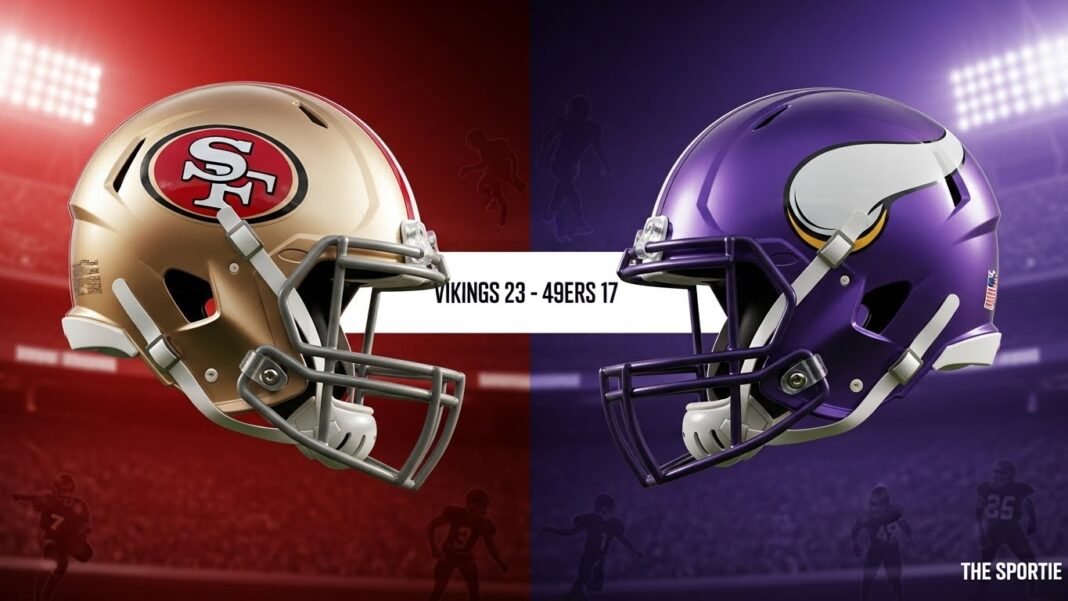
Sam Darnold completed 17 of 26 passes for 268 yards and two touchdowns as the Minnesota Vikings upset the defending NFC champions 23-17 at U.S. Bank Stadium on September 15, 2024. Justin Jefferson scorched the 49ers secondary with 133 yards on just four catches, including a 97-yard touchdown before leaving with a quad injury. Jordan Mason rushed 20 times for 100 yards and a score, but Brock Purdy absorbed six sacks behind a struggling offensive line that couldn’t protect their franchise quarterback. The difference came down to execution on money downs: Minnesota converted 58% of third downs (7 of 12) while San Francisco managed just 20% (2 of 10), a 38-percentage-point gap that extended possessions for the Vikings while the 49ers offense stalled repeatedly.
Table of Contents
Complete Game Leaders
| Category | 49ers Leader | Stats | Vikings Leader | Stats |
|---|---|---|---|---|
| Passing Yards | Brock Purdy | 319 yards, 28/36, 1 TD, 1 INT | Sam Darnold | 268 yards, 17/26, 2 TD, 1 INT |
| Rushing Yards | Jordan Mason | 100 yards, 20 carries, 1 TD | Ty Chandler | 82 yards, 10 carries |
| Receiving Yards | Deebo Samuel | 110 yards, 8 receptions | Justin Jefferson | 133 yards, 4 receptions, 1 TD |
| Sacks | Nick Bosa | 2.0 | Pat Jones II | 2.0 |
| Tackles | Fred Warner | 9 total, 7 solo | Blake Cashman | 13 total, 5 solo |
Jefferson’s 97-yard touchdown catch became the second-longest scoring play in Vikings franchise history, trailing only Gus Frerotte’s 99-yard strike to Bernard Berrian in 2008. His 400th career reception tied Ahmad Rashad for eighth all-time in franchise history. According to Pro Football Reference, Jefferson reached 6,000 career receiving yards in just 62 games, matching the record Lance Alworth set in the 1960s.
Quarterback Performance
| Quarterback | Team | Comp/Att | Yards | TD | INT | Sacks | QBR | Rating |
|---|---|---|---|---|---|---|---|---|
| Brock Purdy | SF | 28/36 | 319 | 1 | 1 | 6-25 | 44.4 | 101.3 |
| Sam Darnold | MIN | 17/26 | 268 | 2 | 1 | 3-10 | 59.8 | 109.1 |
Darnold averaged 10.3 yards per attempt and posted a 109.1 passer rating despite throwing 10 fewer passes. His mobility sustained drives, scrambling five times for 32 yards when pressure collapsed the pocket. More importantly, he converted on third down in critical situations.
Fantasy Impact: Darnold just became a viable streaming option for Week 3. Back-to-back performances with two touchdown passes against quality defenses (Giants, 49ers) suggest he’s not just a game manager filling in before rookie J.J. McCarthy takes over. Should he continue this efficiency beyond October, fantasy managers in 12-team leagues should consider rostering him.
Purdy’s 78% completion rate masks deeper problems. Six sacks for 25 yards lost destroyed any offensive rhythm. Left tackle Trent Williams couldn’t handle Minnesota’s edge pressure throughout the game. The 49ers quarterback completed 28 of 36 passes yet the offense stalled repeatedly in scoring position. Fred Warner’s second quarter interception exposed Purdy forcing throws into coverage without elite weapons bailing him out.
With Darnold playing at this level beyond October, the Vikings face a legitimate quarterback decision for 2025. He’s not playing like a bridge quarterback. He’s playing like a franchise starter.
Ground Game Statistics
| Player | Team | Carries | Yards | Average | TD | Long |
|---|---|---|---|---|---|---|
| Jordan Mason | SF | 20 | 100 | 5.0 | 1 | 22 |
| Ty Chandler | MIN | 10 | 82 | 8.2 | 0 | 25 |
| Aaron Jones | MIN | 9 | 32 | 3.6 | 0 | 9 |
| Sam Darnold | MIN | 5 | 32 | 6.4 | 0 | 18 |
| Brock Purdy | SF | 2 | 12 | 6.0 | 0 | 11 |
| Deebo Samuel | SF | 2 | -10 | -5.0 | 0 | -1 |
Mason just became a must-start RB2 for fantasy owners. His second consecutive 100-yard game demonstrates he can handle a featured workload with Christian McCaffrey on injured reserve. The Georgia Tech product showed patience and burst, averaging 5.0 yards per carry while shouldering 20 attempts. His 10-yard fourth quarter touchdown run gave the 49ers a fighting chance late.
The Uncomfortable Question: Mason averaging 100 yards beyond October creates a dilemma for McCaffrey’s return. The 49ers might’ve accidentally discovered they don’t need to lean entirely on their All-Pro running back. Mason is on a rookie contract while McCaffrey commands premium money. That’s a luxury problem most teams would kill to have, but it’s a real conversation Kyle Shanahan must address in six weeks.
Chandler averaged 8.2 yards per carry on limited touches, repeatedly breaking off chunk gains against San Francisco’s front seven. Brian Flores rotated him with Jones to keep both backs fresh and the 49ers defense guessing on personnel.
Receiving Production
| Player | Team | Receptions | Yards | Average | TD | Long | Targets |
|---|---|---|---|---|---|---|---|
| Justin Jefferson | MIN | 4 | 133 | 33.3 | 1 | 97 | 7 |
| Deebo Samuel | SF | 8 | 110 | 13.8 | 0 | 28 | 10 |
| George Kittle | SF | 7 | 76 | 10.9 | 1 | 25 | 8 |
| Jalen Nailor | MIN | 3 | 54 | 18.0 | 1 | 26 | 4 |
| Brandon Aiyuk | SF | 4 | 43 | 10.8 | 0 | 22 | 5 |
| Jauan Jennings | SF | 2 | 37 | 18.5 | 0 | 25 | 4 |
| Aaron Jones | MIN | 5 | 36 | 7.2 | 0 | 18 | 6 |
Jefferson’s 97-yard touchdown came from Minnesota’s own 3-yard line after San Francisco failed on fourth and goal. Kevin O’Connell called play-action with Darnold dropping back in his own end zone. Jefferson ran a seam route past backup safety George Odum, who was filling in for injured starter Talanoa Hufanga. The All-Pro receiver caught the ball 55 yards downfield and raced diagonally across the field before cutting back to the end zone. NFL Next Gen Stats tracked him traveling 127.5 yards on the play, the most distance covered on any scoring play since player tracking began in 2016.
Fantasy Context: Jefferson left the game in the third quarter after colliding with center Garrett Bradbury. CBS News reported the star receiver said afterward he was “feeling good” and expected to play Week 3 against Houston. Fantasy managers should monitor practice reports Wednesday, but this appears to be a minor injury that won’t sideline him.
Kittle caught all seven targets in his 100th career game, remaining Purdy’s most reliable target in crucial situations. Samuel led all receivers with eight catches but couldn’t find the end zone despite 110 yards.
Nailor stepped into a larger role with Jordan Addison sidelined by an ankle injury. His 26-yard catch on third and eight late in the fourth quarter sealed the victory, converting a crucial down on Minnesota’s clock-killing drive. He’s a streaming option in deep leagues for Week 3 if Addison remains out.
Defensive Dominance: Two Units, Different Results
Fred Warner’s heroics nearly dragged San Francisco back from double-digit deficits, while Blake Cashman anchored Minnesota’s suffocating pressure scheme.
49ers Defense
| Player | Position | Tackles | Solo | Sacks | TFL | PD | QB Hits |
|---|---|---|---|---|---|---|---|
| Fred Warner | LB | 9 | 7 | 1.0 | 1 | 2 | 1 |
| Nick Bosa | DE | 5 | 4 | 2.0 | 2 | 0 | 2 |
| De’Vondre Campbell | LB | 5 | 2 | 0.0 | 1 | 0 | 0 |
| Kevin Givens | DT | 2 | 1 | 1.0 | 1 | 0 | 2 |
Vikings Defense
| Player | Position | Tackles | Solo | Sacks | TFL | PD | QB Hits |
|---|---|---|---|---|---|---|---|
| Blake Cashman | LB | 13 | 5 | 1.0 | 1 | 3 | 1 |
| Ivan Pace Jr. | LB | 9 | 6 | 0.0 | 1 | 0 | 0 |
| Josh Metellus | S | 7 | 5 | 0.0 | 1 | 1 | 0 |
| Patrick Jones II | OLB | 5 | 2 | 2.0 | 2 | 0 | 2 |
| Andrew Van Ginkel | OLB | 4 | 4 | 1.0 | 2 | 1 | 1 |
Warner nearly dragged San Francisco back from double-digit deficits on defensive plays alone. His second quarter interception set up the 49ers’ first touchdown after jumping a route intended for Trent Sherfield. Warner’s third quarter forced fumble at the goal line saved seven points when Aaron Jones appeared destined for a score. Nine tackles, two passes defensed, and two forced turnovers define All-Pro linebacker play.
Cashman led all defenders with 13 tackles and three pass breakups, making plays across the formation in Brian Flores’ aggressive scheme. The Vikings defense recorded six sacks while Bosa’s two sacks couldn’t produce enough disruption to match Minnesota’s collective pressure. Despite his two-sack box score, Bosa was neutralized for most of the game by Minnesota’s quick passing attack and Darnold’s mobility. Jones tallied two sacks for the second straight week, bringing his season total to four through two games. According to Pro Football Focus, Jonathan Greenard added seven pressures without recording an official sack, winning his matchups against San Francisco’s tackles on pass rush attempts.
Flores’ disguised coverages and delayed blitzes confused Purdy repeatedly, while San Francisco’s traditional four-man rush couldn’t produce enough pressure on Darnold to disrupt his timing with receivers. The Vikings won the schematic battle by forcing Purdy into quick decisions under duress.
Team Efficiency: Box Score Analysis
| Category | 49ers | Vikings |
|---|---|---|
| Total Yards | 396 | 403 |
| First Downs | 24 | 17 |
| Third Down Efficiency | 2/10 (20%) | 7/12 (58%) |
| Red Zone Scoring | 2/4 (50%) | 1/3 (33%) |
| Time of Possession | 34:48 | 25:12 |
| Turnovers | 2 | 2 |
Third Down Disparity: The Statistical Breakdown
San Francisco held the ball for nearly 35 minutes and gained more total yards but couldn’t convert in critical moments. Minnesota’s 58% third-down conversion rate compared to San Francisco’s 20% created a 38-percentage-point gap that extended possessions for the Vikings while stalling the 49ers offense.
Both teams turned the ball over twice, but Minnesota’s turnovers came in less damaging situations. Darnold’s interception occurred in the second quarter with the Vikings already leading, while Purdy’s pick led directly to a 49ers touchdown drive that nearly salvaged the game. Time of possession favored San Francisco by nearly 10 minutes, yet the Vikings held the ball during crucial fourth quarter sequences, converting key third downs on their game-sealing drive.
Special Teams: Game-Changing Block
| Kicker | Team | FG Attempts | Long | XP | Points |
|---|---|---|---|---|---|
| Will Reichard | MIN | 3 | 39 | 2/2 | 11 |
| Jake Moody | SF | 1 | 31 | 2/2 | 5 |
C.J. Ham’s blocked punt in the first quarter changed the game’s trajectory. The Vikings fullback timed his rush with precision, striking Mitch Wishnowsky’s punt so cleanly it echoed through U.S. Bank Stadium. Theo Jackson scooped up the loose ball and returned it 37 yards to the San Francisco 24-yard line. Three plays later, Will Reichard connected on a 22-yard field goal to open scoring.
The block gave Minnesota excellent field position and early momentum on offense, defense, and special teams. San Francisco’s punt protection unit completely whiffed on their blocking assignments, a fundamental failure that cost them three points and field position.
The sixth-round rookie from Alabama stayed perfect through two games, connecting on all nine field goal and extra point attempts to start his NFL career. His 39-yarder as time expired in the first half gave Minnesota a 13-7 halftime lead and momentum heading into the locker room.
Three Plays That Decided Everything
The Blocked Punt: First Quarter Momentum Shift
Ham’s special teams brilliance gave Minnesota excellent field position and established early control. Jackson’s 37-yard return set up the Vikings’ first points and sent a message that San Francisco would face resistance in all three phases. The play completely flipped field position and forced the 49ers to play from behind for the first time.
The 97-Yard Bomb: Complete Game Changer
After stuffing San Francisco on fourth and goal from the 2-yard line, Minnesota faced second and nine from their own 3-yard line. O’Connell called a deep shot off play-action that will be replayed for years. Jalen Nailor’s crossing route pulled cornerback Charvarius Ward to the middle, leaving Jefferson isolated on George Odum. The All-Pro receiver torched the backup safety on a seam route. Darnold dropped the ball 55 yards downfield perfectly, hitting Jefferson in stride. The receiver wove across the field and scored a touchdown that gave Minnesota a 10-0 lead and completely flipped the game’s complexion.
Warner’s Goal Line Strip: Saving Grace
Aaron Jones broke free on a screen pass in the third quarter and appeared headed for a touchdown that would’ve buried San Francisco’s comeback hopes. Warner chased him down from behind and punched the ball loose just before Jones crossed the goal line. Yiadom recovered at the 1-yard line to save seven points. Without this defensive gem, the 49ers never get back into striking distance.
Why San Francisco Lost
Pass Protection Breakdown
The offensive line couldn’t handle pressure from multiple angles. Six sacks allowed against any opponent is unacceptable for a Super Bowl contender, let alone against a defense missing several starters from their 2023 unit. Williams struggled against Minnesota’s edge rushers for four quarters, particularly on speed rushes from Jones. The interior couldn’t handle Flores’ A-gap blitzes. Purdy held the ball too long on at least three sacks, but the blocking failures were glaring and systemic.
Red Zone Failures
Shanahan’s play calling is becoming predictable in scoring situations. The 49ers went for it on fourth and goal from the 2-yard line and Purdy’s pass got batted down at the line. Why not give Mason, who averaged 5.0 yards per carry, a chance to punch it in? San Francisco converted just 1 of 3 fourth-down attempts in this game. Going 2 for 4 in red zone opportunities proved too costly in a six-point loss. The failed fourth down attempt and settling for field goals left 11 points on the board.
Questions About Purdy
Is the franchise quarterback regressing without elite weapons constantly bailing him out? He threw an interception Warner saw coming from across the field. His fourth down pass on the goal line had no chance against Minnesota’s coverage. Brandon Aiyuk caught four passes for 43 yards despite his recent contract extension. When the supporting cast isn’t perfect, Purdy looks ordinary. That’s concerning for a team paying him franchise quarterback money and expecting him to carry them through McCaffrey’s absence.
The Vikings covered as 4.5-point home underdogs, their second straight against-the-spread victory to open the season. Minnesota’s defense generated six sacks as a unit while limiting explosive plays after Jefferson’s touchdown. Flores’ scheme confused Purdy with disguised coverages and delayed blitzes throughout the afternoon according to detailed analysis from Pro Football Focus.
Why Minnesota Won
Third Down Mastery
Third down execution separated these teams by 38 percentage points. Minnesota converted 7 of 12 attempts while San Francisco managed just 2 of 10. That disparity extended possessions for the Vikings and forced the 49ers defense to spend extra time on the field despite holding a time of possession advantage. Darnold’s efficiency on money downs proved he can execute O’Connell’s offense in crucial situations.
Darnold’s Validation
The journeyman quarterback proved Week 1 against the Giants wasn’t a fluke. Playing against the team that employed him as a backup in 2023, the 27-year-old displayed composure under pressure and arm talent to attack downfield. That 97-yard touchdown to Jefferson landed 55 yards downfield over the receiver’s shoulder with perfect ball placement. Continuing this production beyond September would establish him as Minnesota’s franchise quarterback.
Defensive Pressure
Minnesota’s pass rush controlled the game with four-man rushes while dropping seven into coverage. The Vikings produced six sacks without relying on blitzes alone. Jones’ four sacks through two games leads the NFL among edge rushers. Van Ginkel’s versatility as a blitzer and coverage linebacker created matchup problems for San Francisco’s protection scheme. Cashman’s 13 tackles included stops in run support and coverage downfield, demonstrating the versatility Flores demands from his linebackers.
Resilience After Jefferson’s Injury
Jefferson’s third quarter exit after colliding with center Bradbury tested Minnesota’s depth. Nailor responded with crucial catches on third down to close out the victory. The Vikings didn’t panic when their best offensive weapon left the game. They leaned on their defense and trusted Darnold to make plays in crucial moments.
According to reports from the Vikings postgame press conference, O’Connell praised his team’s fight: “When you play the defending NFC Conference Champions, you know you are signing up for a 12-round heavyweight fight.” Shanahan admitted: “Give them a lot of credit. They played real well, but it was too sloppy on our part.”
What’s Next For Both Teams
Minnesota’s 2-0 start proves their competitiveness after beating the defending NFC champions at home. The Vikings are now 6-0 at home against San Francisco dating back to 2003, controlling this matchup at U.S. Bank Stadium. They host Houston next, facing C.J. Stroud and a talented AFC South squad coming off a Monday Night Football appearance. Should Minnesota’s defense produce similar pressure against the second-year quarterback, they’ll enter their Week 4 bye at 3-0.
The Vikings’ defense allows just 17 points per game through two weeks while tallying 10 sacks. Jones is on pace for 34 sacks at his current production rate. Darnold has four touchdown passes against two interceptions with a passer rating above 100 in both games. Minnesota appears to be building a legitimate playoff contender, not filling time before a rebuild.
San Francisco drops to 1-1 with problems across multiple areas that need immediate attention. The offensive line needs immediate answers before facing Aaron Donald’s replacement in Los Angeles next week. The 49ers visit the Rams in a division matchup with major implications for NFC West positioning. These protection issues persisting would give Matthew Stafford’s defense an opening to exploit Purdy the same way Minnesota did.
The 49ers coaching staff will evaluate Hufanga’s status throughout the week. Getting their 2022 All-Pro safety back would help a secondary that surrendered Jefferson’s historic touchdown and struggled against Minnesota’s play-action concepts. McCaffrey won’t return until at least Week 6, meaning Mason needs to continue producing as the featured back.
Special teams coordinator Brian Schneider faces questions after the blocked punt disaster. San Francisco’s coverage units have struggled through two weeks, giving up big returns and now a blocked punt that led directly to points. Those mistakes prove costly in close games against quality opponents.
Final Verdict
One team just announced they belong among the NFC elite. The other discovered that life without an All-Pro running back exposes deeper problems than anyone expected. Darnold’s efficiency on third down, Jefferson’s historic 97-yard touchdown, and six sacks of Purdy defined a statement victory for Minnesota.
The Vikings aren’t rebuilding anymore. They’re winning against quality opponents, beating playoff contenders with a quarterback nobody believed in three weeks ago. Minnesota is a legitimate postseason threat.
San Francisco faces significant challenges. The offensive line can’t protect their quarterback in crucial moments. The red zone offense relies too heavily on improvisation rather than execution. Questions about Purdy’s ability to carry this team without perfect supporting talent are legitimate after back-to-back underwhelming performances to open the season. The 49ers remain talented enough to win the NFC West, but the margin for error just shrunk considerably.
For more comprehensive NFL coverage, player analysis, and weekly statistical breakdowns, visit The Sportie for expert insights throughout the football season.