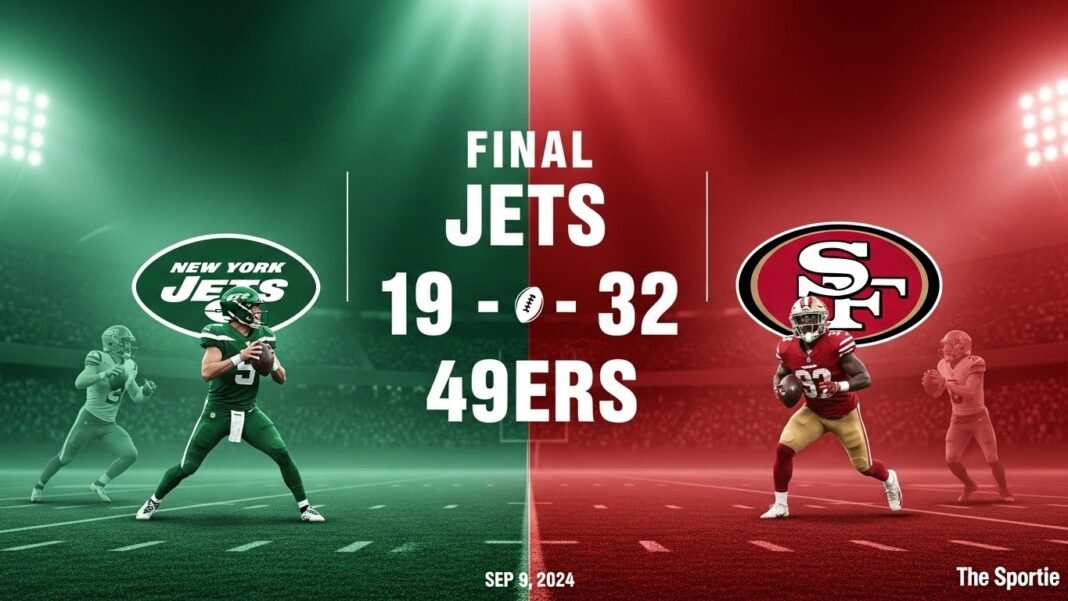
San Francisco crushed the Jets 32-19 at Levi’s Stadium on September 9, 2024. The individual performances from this Monday Night Football opener showed Jordan Mason stepping into the starting role with 147 rushing yards and a touchdown on 28 carries, replacing injured Christian McCaffrey. Brock Purdy completed 19 of 29 passes for 231 yards with zero turnovers, while Aaron Rodgers managed 167 yards, one touchdown, and one interception in his return from a torn Achilles. Jake Moody connected on all six field goal attempts, and Fred Warner forced a fumble while recording seven tackles.
Table of Contents
Game Leaders
| Category | Jets Leader | Stats | 49ers Leader | Stats |
|---|---|---|---|---|
| Passing Yards | Aaron Rodgers | 167 yards, 13/21, 1 TD, 1 INT | Brock Purdy | 231 yards, 19/29, 0 TD, 0 INT |
| Rushing Yards | Breece Hall | 54 yards, 16 carries, 1 TD | Jordan Mason | 147 yards, 28 carries, 1 TD |
| Receiving Yards | Allen Lazard | 89 yards, 6 receptions, 2 TD | Jauan Jennings | 64 yards, 5 receptions |
| Tackles | Tony Adams | 12 total, 8 solo | Fred Warner | 7 total, 5 solo |
| Sacks | Tony Adams, Sauce Gardner, Micheal Clemons | 1.0 each | Leonard Floyd | 1.0 |
San Francisco dominated possession 38:40 to 21:20, running 70 plays compared to New York’s 49. The 49ers scored on eight consecutive drives after their opening series ended in a punt. That control allowed Kyle Shanahan’s offense to wear down the Jets defense while keeping Aaron Rodgers on the sideline watching.
Quarterback Breakdown
| Quarterback | Team | Comp/Att | Yards | TD | INT | Sacks | Rating |
|---|---|---|---|---|---|---|---|
| Aaron Rodgers | NYJ | 13/21 | 167 | 1 | 1 | 1-5 | 82.8 |
| Tyrod Taylor | NYJ | 6/8 | 36 | 1 | 0 | 0-0 | 122.9 |
| Brock Purdy | SF | 19/29 | 231 | 0 | 0 | 2-6 | 89.9 |
Exactly 52 weeks after his Achilles tear ended his 2023 debut after four snaps, Rodgers returned to meaningful action. His first quarter was vintage. The four-time MVP orchestrated a 12-play, 70-yard touchdown drive that showcased everything that made him elite in Green Bay. Three consecutive third down conversions to Garrett Wilson for 16, 14, and 8 yards displayed the precision that terrorized defenses for 15 years.
The touchdown pass to Lazard demonstrated his mastery of the free play. Leonard Floyd jumped offsides on third and eight, and Rodgers immediately recognized the penalty. He launched a 36-yard strike down the sideline, cutting San Francisco’s lead to 26-13. The score marked his 18th career touchdown on a free play, a number no other quarterback approaches.
But the Jets managed just 49 offensive plays total. Rodgers couldn’t establish rhythm when his defense kept giving the ball back to San Francisco. According to NFL Research, the 21:20 possession time set his career low for any game.
Purdy distributed passes to six different receivers, hitting connections of 26, 22, 34, 25, and 15 yards when the 49ers needed chunk plays. He took two sacks but never put the ball in danger. The 34-yard strike to Kyle Juszczyk found the fullback between defenders on a wheel route. Mason punched in a touchdown two plays later, essentially ending the competitive portion of the game.
Rushing Statistics
| Player | Team | Carries | Yards | Average | TD | Long |
|---|---|---|---|---|---|---|
| Jordan Mason | SF | 28 | 147 | 5.3 | 1 | 24 |
| Breece Hall | NYJ | 16 | 54 | 3.4 | 1 | 16 |
| Deebo Samuel | SF | 8 | 23 | 2.9 | 1 | 6 |
| Braelon Allen | NYJ | 1 | 8 | 8.0 | 0 | 8 |
147 yards. 28 carries. First career start. Mason just made Christian McCaffrey’s absence irrelevant. The undrafted third-year back from Georgia Tech carried the ball more times than any 49ers player since Frank Gore’s 29-carry performance against Detroit in 2011. Pro Football Focus tracking data showed Mason averaged 2.9 yards before contact and 2.4 yards after contact, picking up 67 yards after initial contact.
Mason’s five-yard touchdown run defined the night. The drive capped an 11-play, 70-yard march that consumed 7:18 of clock and extended the lead to 23-7. Mason cut back to the right side and walked into the end zone untouched as the Jets defensive front completely lost gap integrity. The score essentially buried New York’s chances of mounting a comeback.
Patience defined his running style. Mason waited for blocks to develop on outside zone runs, then attacked downhill once lanes opened. The offensive line created immediate running room, giving Mason cushion before defenders arrived. Those blocks formed the foundation for his breakout performance.
Hall faced a completely different situation. Averaging just 1.2 yards before contact shows the Jets offensive line couldn’t generate push against San Francisco’s defensive front. Hall scored on a three-yard plunge in the first quarter and added five catches for 39 yards, but the ground game never threatened. New York managed just 68 total rushing yards on 19 carries as a team, numbers that don’t win games in any era.
Receiving Production
| Player | Team | Receptions | Yards | Average | TD | Long | Targets |
|---|---|---|---|---|---|---|---|
| Allen Lazard | NYJ | 6 | 89 | 14.8 | 2 | 36 | 9 |
| Jauan Jennings | SF | 5 | 64 | 12.8 | 0 | 22 | 5 |
| Garrett Wilson | NYJ | 6 | 60 | 10.0 | 0 | 16 | 11 |
| Deebo Samuel | SF | 5 | 54 | 10.8 | 0 | 25 | 9 |
| George Kittle | SF | 4 | 40 | 10.0 | 0 | 26 | 5 |
| Kyle Juszczyk | SF | 2 | 40 | 20.0 | 0 | 34 | 3 |
| Breece Hall | NYJ | 5 | 39 | 7.8 | 0 | 13 | 6 |
Lazard posted career-best numbers in a Jets uniform. Nine targets, six catches, both New York touchdowns. He converted every catchable pass thrown his direction. His second touchdown came from backup Tyrod Taylor with 25 seconds remaining, a meaningless score that made the final margin slightly less embarrassing.
Wilson drew 11 targets but managed just 60 yards on six receptions. The second-year receiver couldn’t produce explosive plays against Deommodore Lenoir’s tight coverage and San Francisco’s disguised coverages. Wilson moved the chains effectively on three first quarter catches, but Lenoir contained him for the rest of the night.
Perfect night for Jennings. Five targets, five catches, 64 yards. His 22-yard grab on third and five in the second quarter kept a critical scoring drive alive. Purdy knew exactly where to find him when the 49ers needed conversions.
Samuel touched the ball 13 times (five catches, eight carries) for 77 combined yards and a touchdown. Shanahan moved him all over the formation, lining him up in the backfield, slot, and outside. The versatility forces defenses to adjust personnel constantly, creating favorable matchups throughout the game. Kittle hauled in four of five targets while providing his usual elite blocking on run plays. His 26-yard catch opened a 12-play field goal drive in the second quarter. Juszczyk’s two receptions averaged 20 yards per catch, both conversions on critical third downs when San Francisco needed to extend drives.
Defense and Turnovers
Jets Defense
| Player | Position | Tackles | Solo | Sacks | TFL | PD | QB Hits |
|---|---|---|---|---|---|---|---|
| Tony Adams | S | 12 | 8 | 1.0 | 0 | 1 | 1 |
| C.J. Mosley | LB | 9 | 8 | 0.0 | 0 | 0 | 0 |
| D.J. Reed | CB | 9 | 7 | 0.0 | 0 | 1 | 0 |
| Quincy Williams | LB | 6 | 5 | 0.0 | 0 | 1 | 0 |
49ers Defense
| Player | Position | Tackles | Solo | Sacks | TFL | PD | QB Hits |
|---|---|---|---|---|---|---|---|
| Fred Warner | LB | 7 | 5 | 0.0 | 0 | 0 | 0 |
| De’Vondre Campbell | LB | 5 | 2 | 0.0 | 1 | 0 | 0 |
| Isaac Yiadom | CB | 4 | 4 | 0.0 | 0 | 1 | 0 |
| Deommodore Lenoir | CB | 4 | 3 | 0.0 | 0 | 1 | 0 |
| Leonard Floyd | DE | 2 | 1 | 1.0 | 1 | 0 | 1 |
Adams led all defenders with 12 tackles, flying around the field despite San Francisco’s offensive dominance. His safety blitz sack and consistent presence in run support couldn’t prevent the 49ers from accumulating 401 total yards. The Jets defense spent too much time on the field, wearing down as the game progressed.
Warner’s forced fumble on the second possession changed the game. Warner punched the ball loose from Hall’s grasp before the running back secured possession. Maliek Collins recovered at the Jets 32-yard line. San Francisco converted with Moody’s 46-yard field goal three plays later. The turnover forced New York to play from behind for the rest of the night.
Warner struck again later in the game. Trailing 23-7, Rodgers targeted Wilson on a crossing route. Lenoir deflected the pass at the line, popping it into the air where Demetrius Flannigan-Fowles grabbed it at the San Francisco 46. The takeaway killed New York’s best scoring opportunity of the second half. Moody drilled a 53-yarder moments later that extended the lead to 26-7.
Floyd beat right guard Alijah Vera-Tucker clean on a speed rush in the second quarter for his sack. The pressure forced two consecutive three and outs, helping San Francisco build a 16-7 halftime lead. Nick Bosa generated two quarterback hits without recording a sack as New York’s offensive line gave him constant attention.
Special Teams Excellence
| Kicker | Team | FG Made/Att | Long | XP Made/Att | Points |
|---|---|---|---|---|---|
| Jake Moody | SF | 6/6 | 53 | 2/2 | 20 |
| Greg Zuerlein | NYJ | 0/0 | N/A | 1/1 | 1 |
Moody went six for six. He matched the franchise record for field goals in a single game, connecting from 46, 51, 31, 53, 23, and 42 yards. Those 18 points accounted for more than half of San Francisco’s scoring output. The Alabama product showed range and accuracy on kicks from multiple distances and hash marks.
The 53-yard field goal after Warner’s interception pushed the lead to 26-7, effectively ending any realistic comeback hopes. Six attempts, six makes, zero drama. That’s how you win the kicking battle.
Mitch Wishnowsky punted once for 58 yards as the 49ers offense sustained drives throughout the night. Xavier Gipson returned three kickoffs for 77 yards (25.7 average) and one punt for four yards. Thomas Morstead punted three times for 160 yards, averaging 53.3 yards per attempt with a long of 60 yards.
Team Efficiency Comparison
| Category | Jets | 49ers |
|---|---|---|
| Total Yards | 266 | 401 |
| First Downs | 14 | 24 |
| Third Down Conversion | 6/10 (60%) | 6/13 (46%) |
| Fourth Down Conversion | 0/1 (0%) | 0/0 (0%) |
| Red Zone Scoring | 2/2 (100%) | 2/5 (40%) |
| Time of Possession | 21:20 | 38:40 |
| Turnovers | 2 | 0 |
| Penalties | 3-10 | 4-40 |
San Francisco’s 17-minute possession advantage controlled the game. San Francisco controlled the ball by winning on early downs, converting 10 of their 24 first downs on the ground. They ran 38 times for 180 yards at 4.7 yards per carry as a team. That ground game kept the chains moving without relying on Purdy to make difficult throws.
New York converted 60% of third downs but couldn’t overcome two turnovers. Hall’s fumble and Rodgers’ interception both led directly to San Francisco field goals. Those six points from takeaways, combined with the possession advantage, created a deficit the Jets couldn’t erase.
San Francisco scored touchdowns on just two of five red zone trips. Robert Saleh’s defense held firm in short yardage situations, forcing Moody into action rather than allowing easy touchdowns. But those repeated trips to the red zone showed San Francisco’s ability to move the ball consistently between the 20s.
Advanced Passing Metrics
| Quarterback | Air Yards/Att | Completed Air Yards | YAC | Drops | Bad Throws | Pressure Rate |
|---|---|---|---|---|---|---|
| A. Rodgers | 7.3 | 74 | 93 | 2 | 4 | 18.2% |
| B. Purdy | 9.1 | 166 | 65 | 1 | 5 | 18.8% |
Purdy’s 9.1 air yards per attempt shows San Francisco’s willingness to attack downfield vertically. His 166 completed air yards nearly doubled Rodgers’ total of 74. That difference reflects both opportunity (70 plays vs 49) and aggressive play calling from Shanahan. The 49ers pushed the ball downfield while the Jets settled for shorter completions underneath.
Both quarterbacks faced similar pressure rates around 18%, meaning pass protection wasn’t the difference. Purdy’s mobility and quick release helped him avoid sacks when protection broke down. His two sacks for 10 yards compared favorably to Rodgers taking one for five yards.
Advanced Rushing Metrics
| Player | Yards Before Contact | Yards After Contact | Broken Tackles |
|---|---|---|---|
| J. Mason | 80 | 67 | 1 |
| B. Hall | 19 | 35 | 1 |
Mason’s 80 yards before contact shows the offensive line created immediate running lanes at the snap. That 2.9 yards of cushion before defenders arrived separates elite rushing attacks from average ones. When running backs hit holes with momentum already built, they gain chunks rather than grinding for every yard.
Contrast that with Hall’s 1.2 yards before contact. The Jets offensive line couldn’t create push at the point of attack, forcing Hall to make defenders miss in the backfield. His 35 yards after contact shows effort, but no running back succeeds consistently when meeting defenders behind the line of scrimmage.
Critical Moments
Hall’s fumble on the second possession killed any momentum from New York’s opening drive. Warner ripped the ball loose before the running back could secure possession. Collins recovered at the Jets 32, giving San Francisco a short field that led to Moody’s opening field goal. That turnover forced New York into comeback mode from the first quarter onward.
San Francisco’s opening drive of the second half buried the Jets. The 11-play, 70-yard march consumed 7:18 of clock. Mason’s five-yard touchdown extended the lead to 23-7. Purdy’s 34-yard strike to Juszczyk earlier in the drive converted third and two at a critical juncture. That scoring drive demonstrated everything working in San Francisco’s offense.
Trailing 23-7, Rodgers targeted Wilson on a crossing route. Lenoir deflected the pass at the line, popping it into the air. Flannigan-Fowles grabbed the interception at the 46-yard line, killing any comeback hopes. Moody connected on a 53-yarder shortly after, extending the lead to 26-7.
Rodgers’ touchdown to Lazard provided brief hope. Down 26-7, he drew Floyd offsides on third and eight. Recognizing the free play immediately, he launched a 36-yard strike down the sideline that cut the deficit to 26-13. But Hall’s failed two-point conversion kept it a two-possession game, and the Jets never seriously threatened again.
Season Impact
Mason’s breakout gave San Francisco confidence they could survive McCaffrey’s absence. He carried the load again in Week 2, rushing for 100 yards against Minnesota before the 49ers fell 23-17 on the road. His consecutive 100-yard performances bought Kyle Shanahan’s staff time to manage McCaffrey’s calf and Achilles injuries carefully without rushing their All-Pro back onto the field prematurely.
The 49ers proved their offensive system produces regardless of personnel. Shanahan’s scheme creates opportunities that capable backs can exploit. Mason’s success validated the organizational belief that running back production comes from scheme and offensive line play as much as individual talent.
The Jets dropped to 0-1 in Rodgers’ return. Their defense couldn’t get off the field, allowing eight consecutive scoring drives after the opener. New York managed just 49 offensive plays compared to San Francisco’s 70, limiting opportunities for Rodgers to establish rhythm with his receivers.
The opener exposed concerns about offensive line pass protection and defensive run stopping that would need immediate attention. New York faced Tennessee in Week 2 with those issues still unresolved. The Jets needed to address these problems quickly to remain competitive in the AFC East race.
San Francisco controlled every phase in their 32-19 season-opening victory, from Mason’s 147 rushing yards to Warner’s defensive playmaking to Moody’s perfect six-for-six kicking performance.