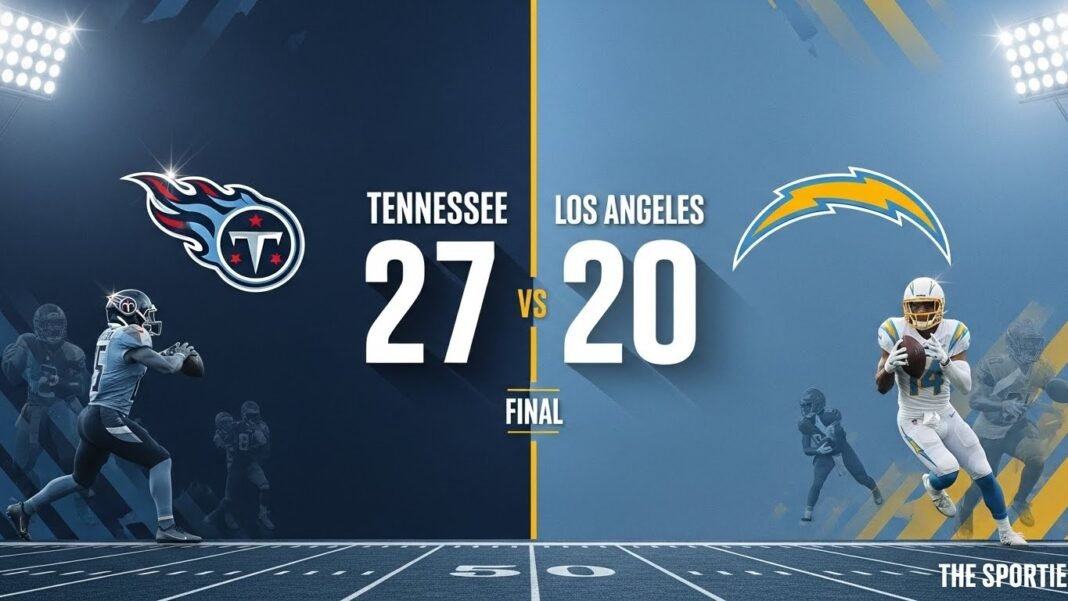
Justin Herbert threw for 250 yards with two touchdowns and ran for another score as the Chargers defeated Tennessee 27-20 at Nissan Stadium on November 2, 2025. The win pushed Los Angeles to 6-3 while the Titans dropped to 1-8. Cedric Gray dominated defensively with 16 tackles for Tennessee, while Cody Barton’s 24-yard pick-six and Chimere Dike’s 67-yard punt return touchdown gave the home crowd brief hope in a chaotic first quarter before Herbert took control.
Table of Contents
Quarterback Comparison
| Player | Team | Comp/Att | Yards | TD | INT | Sacks | Rating |
|---|---|---|---|---|---|---|---|
| Justin Herbert | LAC | 19/29 | 250 | 2 | 1 | 6-38 | 101.2 |
| Cam Ward | TEN | 12/21 | 145 | 0 | 0 | 4-27 | 78.5 |
Herbert bounced back from the early pick-six without missing a beat. The veteran completed 65.5 percent of his passes and averaged 8.6 yards per attempt despite taking six sacks behind an offensive line that lost multiple starters during the game. His adjusted completion percentage hit 80 percent when you account for drops and throwaways. More importantly, he found five different receivers on third down and used his legs to convert crucial short-yardage situations throughout the fourth quarter.
Ward completed 57.1 percent of his throws but couldn’t find the end zone through the air for the second straight week. Tennessee’s first overall pick managed just 6.9 yards per attempt against a Chargers defense that brought consistent pressure. Ward showed accuracy on intermediate routes but lacked explosive downfield connections. The Titans averaged just 4.7 yards per play compared to Los Angeles’ 5.3.
Ground Attack
| Player | Team | Carries | Yards | Average | TD | Long |
|---|---|---|---|---|---|---|
| Justin Herbert | LAC | 9 | 57 | 6.3 | 1 | 29 |
| Tony Pollard | TEN | 10 | 56 | 5.6 | 0 | 16 |
| Jaret Patterson | LAC | 9 | 44 | 4.9 | 0 | 9 |
| Kimani Vidal | LAC | 12 | 30 | 2.5 | 0 | 7 |
| Tyjae Spears | TEN | 7 | 26 | 3.7 | 0 | 10 |
Herbert led all rushers with 57 yards and proved unstoppable in short-yardage situations. The 6-foot-6 quarterback converted three separate third-and-one sneaks in the fourth quarter. The final one? A one-yard touchdown plunge that pushed the lead to 27-17 with 12:58 remaining. When pocket protection broke down, Herbert picked up first downs with his legs on multiple scrambles, including a 29-yard gain that kept the crucial 99-yard drive alive.
Pollard churned out 56 yards on 10 carries but couldn’t punch it in from the one-yard line when it mattered most. Back-to-back stuffs on third and fourth down in the third quarter shifted the entire game. That goal-line failure gave Los Angeles possession at their own one, setting up the knockout blow. Patterson provided solid relief work with 44 yards on nine touches, helping the Chargers control possession for 34:20.
Pass Catchers
| Player | Team | Receptions | Targets | Yards | TD | Long |
|---|---|---|---|---|---|---|
| Oronde Gadsden II | LAC | 5 | 5 | 68 | 0 | 34 |
| Ladd McConkey | LAC | 4 | 6 | 56 | 0 | 21 |
| Quentin Johnston | LAC | 4 | 6 | 53 | 1 | 23 |
| Keenan Allen | LAC | 2 | 5 | 41 | 0 | 31 |
| Elic Ayomanor | TEN | 3 | 6 | 46 | 0 | 29 |
| Tyjae Spears | TEN | 3 | 3 | 36 | 0 | 26 |
Johnston hauled in Herbert’s best throw of the afternoon. The 19-yard back-shoulder fade in the second quarter came with tight defensive coverage. Herbert dropped the ball over the defender’s outstretched arms and into Johnston’s catch radius in the back corner of the end zone. The touchdown gave Los Angeles a 17-14 lead and marked Johnston’s sixth touchdown reception through nine games after catching eight all of last season.
McConkey became Herbert’s most reliable target on money downs. Four third-down receptions extended scoring drives, including a crucial 21-yard catch during the marathon 99-yard touchdown drive. Gadsden caught all five targets for 68 yards, providing a consistent intermediate option. His 34-yard grab in the first quarter set up an early touchdown and showed why tight ends remain essential in Greg Roman’s offense.
Defensive Dominance
Tackle Leaders
| Player | Team | Total | Solo | TFL | Sacks | QB Hits |
|---|---|---|---|---|---|---|
| Cedric Gray | TEN | 16 | 11 | 1 | 1.0 | 1 |
| Daiyan Henley | LAC | 9 | 4 | 1 | 1.0 | 1 |
| Derwin James Jr. | LAC | 8 | 5 | 0 | 0.0 | 1 |
| Denzel Perryman | LAC | 7 | 5 | 0 | 0.0 | 0 |
| Amani Hooker | TEN | 7 | 6 | 0 | 0.0 | 0 |
Sixteen tackles. One sack. First career sack at that. Gray now has 87 tackles through nine games, ranking second in the NFL behind only Miami’s Jordyn Brooks. He became the first Titans player since 2000 to record multiple games with at least 16 tackles in a single season, according to Pro Football Reference.
Gray showed excellent range in coverage while diagnosing plays before the snap. He chased down ball carriers from backside pursuit angles all afternoon, one of the few consistent performers on a defense that ranks 30th in points allowed. Makes you wonder what tape the other 31 teams were watching during the draft. Gray’s second 16-tackle performance of 2025 came after posting 17 stops against Houston in Week 4. He’s continuing Tennessee’s tradition of elite linebacker play that stretches back through Keith Bulluck’s era.
Pass Rush Production
| Player | Team | Sacks | QB Hits | Hurries | Pressures |
|---|---|---|---|---|---|
| Odafe Oweh | LAC | 2.0 | 2 | 2 | 4 |
| Jihad Ward | TEN | 2.5 | 4 | 4 | 5 |
| Dre’Mont Jones | TEN | 1.5 | 4 | 4 | 7 |
| Tuli Tuipulotu | LAC | 1.0 | 1 | 2 | 3 |
Ward harassed Herbert all afternoon, recording 2.5 sacks and four quarterback hits in his best game as a Titan. He dropped the Chargers quarterback for a six-yard loss in the first quarter, added another six-yarder in the second, and combined with Jones for a shared sack in the third. The performance marked just the fourth time in the past 10 seasons that a Titans player recorded at least 2.5 sacks in a single game, joining Cameron Wake (2019), Jeffery Simmons (2021), and Harold Landry III (2023).
Jones extended his sack streak to four consecutive games. Only Harold Landry III and Denico Autry (both in 2021) have posted longer streaks for the Titans in recent memory. His 4.5 sacks through nine games ties Simmons for the team lead despite Simmons missing this contest. The defensive tackle has posted at least four sacks in six straight seasons dating back to Denver.
Oweh delivered both sacks in the fourth quarter when Tennessee tried mounting a comeback. The edge rusher has 4.0 sacks since arriving from Baltimore in an early October trade, giving defensive coordinator Jesse Minter another weapon opposite Khalil Mack.
Special Teams Explosion
| Player | Team | Type | Returns | Yards | Average | Long | TD |
|---|---|---|---|---|---|---|---|
| Chimere Dike | TEN | Punt | 3 | 98 | 32.7 | 67 | 1 |
| Chimere Dike | TEN | Kick | 4 | 117 | 29.3 | 31 | 0 |
| KeAndre Lambert-Smith | LAC | Kick | 2 | 49 | 24.5 | 30 | 0 |
Dike caught the ball near midfield, made the first Chargers defender miss with a subtle jump cut, then found green grass down the right sideline. Sixty-seven yards later, he was in the end zone. “I knew it was a touchdown,” Dike said afterward. “I’m more happy for our unit. We talk about it all the time. So, those guys work their tail off for me every Sunday.”
The score late in the first quarter pushed Tennessee ahead 14-7 and marked the Titans’ first punt return touchdown since Darius Reynaud had two against Jacksonville on December 30, 2012. Combined with Barton’s pick-six, it represented the first time Tennessee scored touchdowns on both defense and special teams in the same game since that Jacksonville contest.
The performance gave Dike 220 all-purpose yards, making him the first Tennessee rookie in franchise history to log multiple games with at least 200 all-purpose yards. His 98 yards on three punt returns was the highest single-game punt return total by a Titans player since Reynaud’s franchise record 160 yards in 2012.
Dike also surpassed 1,000 kickoff return yards on the season, joining Pacman Jones (2005) and Marc Mariani (2010) as just the third rookie in team history to reach that milestone. His 29.3-yard average on kickoff returns ranks among the league leaders and provides consistently favorable field position for an offense averaging just 13.8 points per game.
Kicking Battle
| Player | Team | Field Goals | Longest | Extra Points | Points |
|---|---|---|---|---|---|
| Cameron Dicker | LAC | 2/2 | 52 | 3/3 | 9 |
| Joey Slye | TEN | 2/2 | 49 | 2/2 | 8 |
Dicker connected from 52 yards with 20 seconds left in the first half, giving the Chargers a 20-17 halftime lead. Jim Harbaugh trusted his kicker from beyond 50 rather than trying to gain more yardage, and Dicker split the uprights with room to spare. His nine points accounted for one-third of Los Angeles’ scoring.
Slye matched with perfect kicking, including a 37-yarder that pulled Tennessee within 27-20 with 4:19 left. But the Titans never touched the ball again as Herbert and the offense bled out the remaining clock.
First Quarter Chaos
The opening period belonged to defense and special teams. Three touchdowns scored before either offense found the end zone. Titans linebacker Cody Barton stepped in front of Herbert’s pass intended for Keenan Allen on just the second offensive play and returned it 24 yards for a touchdown. The pick-six gave Tennessee an immediate 7-0 lead and marked the defense’s first touchdown of 2025.
Herbert answered on the next possession with a seven-play, 76-yard drive capped by a two-yard touchdown toss to fullback Scott Matlock. The score tied things at 7 and gave Matlock his first career touchdown reception. Rookie tight end Oronde Gadsden grabbed the football for his teammate as Matlock spiked it and started running off the field before realizing he should keep the memento.
Dike’s 67-yard punt return pushed Tennessee back ahead 14-7 with 2:55 left in the opening period.
The Sequence That Decided Everything
Tennessee drove to the Los Angeles one-yard line midway through the third quarter, trailing 20-17. Running back Tony Pollard took consecutive handoffs on third and fourth down. Khalil Mack stuffed the third-down attempt. Then Elijah Molden and Denzel Perryman combined to deny the fourth-down try. Film review showed Molden blowing up the play despite using only one hand, with Perryman finishing the tackle.
The gap between playoff contender and one-win team? Right there in that sequence.
Herbert took over at his own one-yard line and led a 15-play, 99-yard touchdown drive that consumed 9:03 of clock. The march featured clutch conversions to McConkey and Gadsden, plus a 23-yard strike to Johnston that moved the ball into the red zone. Herbert capped it with his one-yard rushing touchdown at 12:58 of the fourth quarter, punctuating the score with a celebratory slide. The sequence transformed a three-point game into a 27-17 lead that Tennessee couldn’t overcome.
“The big turning point obviously is getting stopped on the one-yard line, then a big drive go down there and score so that’s the difference,” interim coach Mike McCoy said afterward, per the Titans team site.
Third Down Efficiency Gap
Los Angeles converted 7 of 13 third-down attempts (53.8 percent). Tennessee managed 1 of 9 (11.1 percent). That’s your ballgame.
The Titans entered Week 9 ranked dead last in the NFL on third down at 29.91 percent. This performance didn’t help. Herbert completed passes to five different receivers on money downs while also converting three third downs via scrambles. When pass rushers collapsed the pocket, Herbert extended plays with his mobility, forcing Tennessee defenders to maintain coverage longer than their rush could sustain.
Ward’s four sacks created long-distance situations Tennessee couldn’t overcome. The Titans faced third-and-11 or longer four times, converting none. Their lone third-down conversion came on a Ward scramble that gained minimal yardage but moved the chains. Greg Roman’s game plan attacked Tennessee’s coverage weaknesses, helping the Chargers run 65 total plays compared to the Titans’ 44.
Statistical Summary
| Category | Chargers | Titans |
|---|---|---|
| First Downs | 21 | 10 |
| Total Yards | 343 | 206 |
| Passing Yards | 212 | 118 |
| Rushing Yards | 131 | 88 |
| Third Down | 7-13 | 1-9 |
| Red Zone | 3-4 | 0-2 |
| Turnovers | 1 | 0 |
| Penalties | 3-20 | 7-60 |
| Possession | 34:20 | 25:40 |
Los Angeles generated 11 more first downs while running 21 more plays and controlling possession for nearly nine additional minutes. That advantage limited Ward’s opportunities to find rhythm. The 137-yard difference in total offense shows how far apart these teams are right now.
Tennessee committed seven first-half penalties for 60 yards. The Titans cleaned up those mistakes after intermission, but the damage was done. False starts and holding calls repeatedly put the offense behind schedule and created unconvertible third-down situations.
Standout Performances
Herbert took six sacks behind an offensive line that lost Joe Alt (ankle) and Bobby Hart (groin/ankle) during the game yet kept the offense ahead of schedule. The early pick-six could have derailed things, but Herbert responded with a touchdown drive on the next possession. His 99-yard scoring march from the one-yard line in the third quarter demonstrated the kind of composure that wins playoff games.
Gray’s 16-tackle performance gave him 87 through nine games, second in the NFL. The rookie added his first career sack and demonstrated range in coverage while chasing down ball carriers from backside pursuit angles. He’s continuing Tennessee’s tradition of elite linebacker play dating back to Keith Bulluck. Pairing Gray with a healthy Jeffery Simmons and continued development from the secondary could transform this defense.
Dike’s 220 all-purpose yards included game-breaking returns on both punts and kickoffs. His 67-yard punt return touchdown gave Tennessee a 14-7 lead and gave the home crowd something to celebrate during a frustrating season. The rookie gives Tennessee a game-breaking returner and emerging receiver for the future.
Playoff Picture Impact
The Chargers improved to 6-3 and currently hold the sixth seed in the AFC playoff race as they prepare for a crucial Week 10 primetime matchup against Pittsburgh. Herbert’s performance keeps him in Pro Bowl consideration with 2,390 passing yards through nine games. The Chargers have found an identity as a balanced offense that controls the clock when necessary, exemplified by that 99-yard touchdown drive.
The offensive line situation remains concerning after losing Alt to another ankle injury in the second quarter. Alt lasted only 27 snaps before re-aggravating a previous issue. Hart also left with injuries. Depth will be tested over the final eight games. Trey Pipkins and Jamaree Salyer filled in admirably, but facing Pittsburgh’s defense without two starters presents a real challenge.
Tennessee dropped to 1-8 and enters a bye week before hosting Houston on November 16. The Titans rank last in scoring at 13.8 points per game and 30th in points allowed at 28.8 per contest. Ward’s development remains the top priority for a franchise that used the first overall pick on him. The receiving corps lacks a true number-one option, while the offensive line has allowed 38 sacks through nine games.
The defense showed improvement with six sacks and Barton’s pick-six, but allowing 27 points to a Chargers offense that lost multiple linemen during the game raises questions about consistency. Coordinator Dennard Wilson faces challenges with four defensive starters sidelined, including Simmons and cornerback L’Jarius Sneed. The bye week provides time to regroup before the season’s final stretch.
For complete NFL coverage and in-depth statistical analysis throughout the season, visit The Sportie.