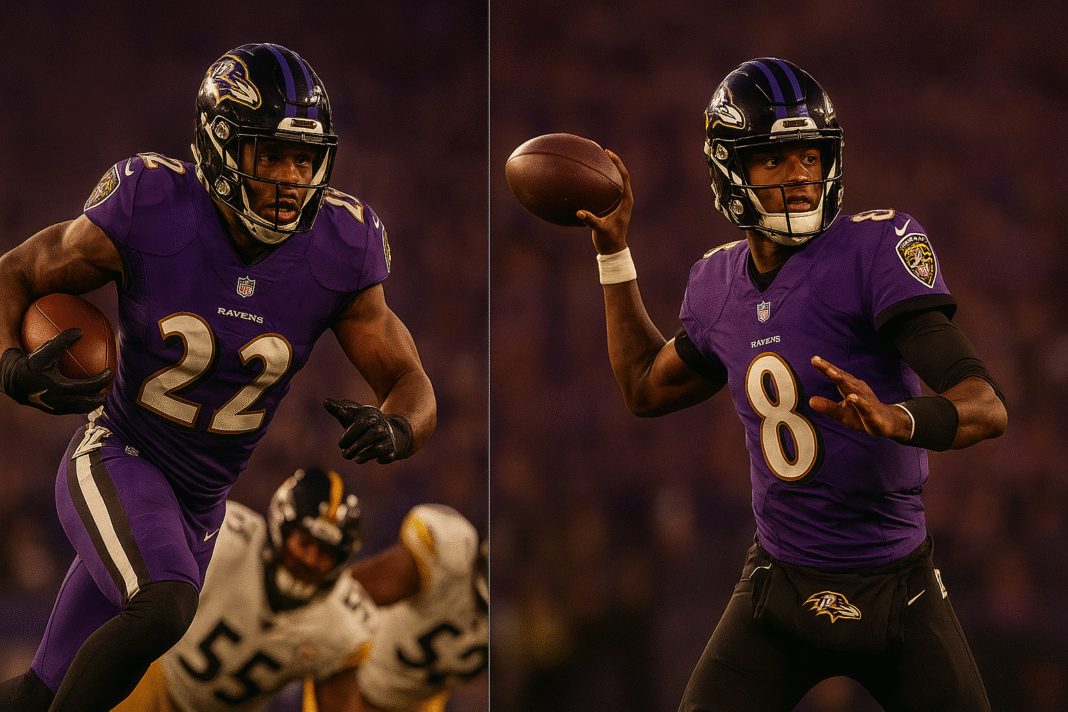
Pittsburgh’s defense had no answers for Baltimore’s ground assault on January 11, 2025. The Ravens rushed for 299 yards at M&T Bank Stadium, setting a franchise playoff record and ending the Steelers’ season with their sixth consecutive postseason defeat. Derrick Henry’s 186-yard performance and Lamar Jackson’s dual-threat excellence created a mismatch that Mike Tomlin’s squad couldn’t overcome.
At a Glance: Essential Game Data
Final Result: Baltimore 28, Pittsburgh 14
Venue: M&T Bank Stadium, Baltimore, MD
Date: Saturday, January 11, 2025
Crowd: 70,546
Temperature: 32°F, 54% humidity, 12 mph wind
Defining Statistics:
- Baltimore rushing total: 299 yards (Pittsburgh playoff record allowed)
- Derrick Henry: 26 rushes, 186 yards, 2 touchdowns
- Lamar Jackson: 16-of-21 passing, 175 yards, 2 TDs, 81 rushing yards
- Pittsburgh rushing total: 29 yards on 11 attempts
- Time of possession: Baltimore 39:33, Pittsburgh 20:27
Table of Contents
How Baltimore Controlled Every Phase
The Ravens dominated from opening kickoff to final whistle. They converted 10 of 15 third downs while Pittsburgh managed just 5 of 11. Baltimore ran 27 more plays (72 to 45), held the ball for 13 more minutes, and outgained the Steelers by 184 yards.
| Metric | Baltimore | Pittsburgh |
|---|---|---|
| Total Yards | 464 | 280 |
| First Downs | 29 | 11 |
| Third Down Success | 66.7% | 45.5% |
| Plays Run | 72 | 45 |
| Average Gain | 6.4 | 6.2 |
| Rushing Yards | 299 | 29 |
| Passing Yards | 165 | 251 |
The rushing yardage gap explains Baltimore’s dominance completely. The Ravens averaged 6.0 yards per carry while Pittsburgh managed just 2.6. Every Baltimore handoff gained more than twice what the Steelers could produce on the ground.
First Quarter: Baltimore’s Physical Statement
Baltimore’s opening possession established physical dominance immediately. The Ravens marched 95 yards on 13 plays, consuming 7 minutes and 13 seconds. Henry’s 34-yard run on the drive featured a punishing stiff arm that dropped Minkah Fitzpatrick to the turf. Jackson capped the series with a 15-yard touchdown pass to Rashod Bateman on 3rd-and-13.
Pittsburgh’s offense couldn’t respond. Three consecutive three-and-outs gave Baltimore short fields and allowed the defense to tee off on Russell Wilson. By the end of the first quarter, the Ravens led 7-0 and had already established complete control.
Second Quarter: Jackson and Henry Break Pittsburgh’s Will
Baltimore’s second touchdown drive exemplified their dominance. Thirteen consecutive running plays. Not a single pass attempt. The Ravens moved 85 yards in nearly eight minutes, with Henry carrying six times for 28 yards. His 8-yard touchdown run made it 14-0 with 4:09 remaining in the half.
Pittsburgh finally showed life when Wilson connected with Van Jefferson for 30 yards, but the drive stalled. Baltimore took over at their own 10 with 1:57 left before halftime.
The sequence that followed changed the game’s complexion entirely. Jackson orchestrated a quick strike, moving the Ravens 90 yards in under two minutes. With 11 seconds left and the ball at Pittsburgh’s 5-yard line, Jackson scrambled under pressure. Defenders closed in from multiple angles. He kept the play alive, moving toward the sideline while the clock ticked down. At the last possible moment, he found Justice Hill in the flat. Hill walked into the end zone with 2 seconds remaining.
The touchdown pushed Baltimore’s lead to 21-0 entering halftime. Pittsburgh’s defense had allowed 308 yards and couldn’t get off the field on third down. The Steelers’ offense had managed just 60 yards and two first downs.
Lamar Jackson’s Complete Performance
Jackson delivered efficiency when Baltimore needed it most. His 76.2% completion rate led all quarterbacks in the Wild Card round.
Pro Football Focus assigned Jackson a 92.9 grade, his highest playoff mark ever. Next Gen Stats credited him with a +16.3% Completion Percentage Over Expected, meaning he completed 16% more passes than average quarterbacks would have given the difficulty of his throws.
His two touchdown passes came on critical downs. The 15-yard strike to Bateman on 3rd-and-13 required perfect timing and placement. The pre-halftime score to Hill showed elite improvisation under pressure.
Jackson’s rushing ability kept Pittsburgh’s defense off balance throughout. His 81 yards on 15 carries included several critical third-down conversions. When protection broke down, he extended plays with his legs rather than taking sacks or forcing bad throws.
Derrick Henry Demolishes Pittsburgh’s Front Seven
Henry’s playoff debut as a Raven exceeded all expectations. His 186 yards broke the franchise’s single-game playoff rushing record and represented the most yards Pittsburgh has allowed in any postseason game across 90 years of franchise history.
His 7.2 yards per carry crushed the NFL average of 4.2. That three-yard advantage per attempt meant Baltimore’s offense operated with a massive efficiency edge. First downs came easier. Scoring opportunities multiplied. Clock control suffocated Pittsburgh’s chances.
Three carries defined Henry’s night. The 34-yard burst on Baltimore’s opening drive announced his presence with a violent stiff arm. His 8-yard touchdown in the second quarter capped the all-run drive that broke Pittsburgh’s spirit. The 44-yard touchdown in the third quarter, where Next Gen Stats clocked him at 20.60 mph, erased any hope of a Steelers comeback.
Henry forced 12 missed tackles despite facing a stacked box on most carries. Pittsburgh defenders couldn’t bring down the 242-pound back cleanly, and yards after contact piled up. His 157 yards after contact ranked third among all players in any game during the 2024 season.
Baltimore’s Receiving Options Spread Production
Without injured star Zay Flowers, Baltimore’s passing game adjusted by distributing targets across multiple receivers.
| Player | Targets | Catches | Yards | TDs | Long |
|---|---|---|---|---|---|
| Isaiah Likely | 4 | 3 | 53 | 0 | 25 |
| Rashod Bateman | 2 | 2 | 24 | 1 | 15 |
| Mark Andrews | 3 | 2 | 27 | 0 | 20 |
| Nelson Agholor | 1 | 1 | 25 | 0 | 25 |
| Justice Hill | 4 | 4 | 13 | 1 | 7 |
| Tylan Wallace | 2 | 1 | 21 | 0 | 21 |
| Anthony Miller | 3 | 3 | 12 | 0 | 5 |
Likely led all Ravens receivers with 53 yards on three catches. His ability to find soft spots in zone coverage gave Jackson reliable underneath options when Pittsburgh’s defense focused on stopping deep shots.
Bateman’s opening touchdown came on the game’s most critical down. Third-and-13 from Pittsburgh’s 15-yard line. Jackson delivered a perfect strike that Bateman caught in stride crossing the goal line. The score announced Baltimore’s intent to attack downfield despite conditions.
Hill’s touchdown reception created instant playoff lore. The five-yard catch required no athletic brilliance, just being in the right spot when Jackson’s scramble drill created chaos. Hill’s four catches for 13 yards also included several critical third-down conversions that sustained drives.
Russell Wilson’s Misleading Statistics
Wilson’s final numbers suggest competent quarterback play. Context changes everything.
| Stat | 1st Half | 2nd Half | Game Total |
|---|---|---|---|
| Completions-Attempts | 7-9 | 13-20 | 20-29 |
| Yards | 44 | 226 | 270 |
| Touchdowns | 0 | 2 | 2 |
| Interceptions | 0 | 0 | 0 |
| Sacks | 2 | 2 | 4 |
Wilson completed just 7 of 9 passes for 44 yards before halftime while Baltimore built an insurmountable lead. His two touchdown throws came after the outcome was decided. The 30-yard connection with Van Jefferson cut the deficit to 21-7. George Pickens’ 36-yard touchdown reception made it 28-14. Both scores arrived too late to threaten Baltimore’s control.
Baltimore’s pass rush generated constant pressure without exotic blitzes. Four sacks for 19 yards lost came at critical moments, killing drives and pushing field goals out of range. Wilson faced pressure on 34% of dropbacks according to Pro Football Focus, forcing quick decisions that prevented Pittsburgh’s offense from operating efficiently.
His 121.3 passer rating and zero turnovers don’t capture the reality that Pittsburgh’s offense never functioned when the game hung in balance. Two first downs before halftime. Three consecutive three-and-outs to start the game. Wilson executed well in garbage time but couldn’t produce when his team needed scores.
George Pickens: Pittsburgh’s Lone Bright Spot
Pickens caught every target thrown his way, finishing with five receptions for 87 yards and a spectacular touchdown.
His 36-yard touchdown grab showcased elite body control. Pickens tracked the deep ball over his shoulder, adjusted to Wilson’s placement, avoided a closing safety, and walked into the end zone untouched. The play demonstrated why evaluators consider him one of the NFL’s rising receiving talents.
Pittsburgh’s puzzling decision to not target their best weapon until late in the second quarter drew postgame criticism. Pickens could have provided early offense when the Steelers desperately needed to match Baltimore’s physicality. Instead, he became a second-half afterthought in a game decided by halftime.
Other Pittsburgh receivers combined for modest production:
| Player | Receptions | Yards | TDs | Long |
|---|---|---|---|---|
| Najee Harris | 3 | 41 | 0 | 21 |
| Van Jefferson | 2 | 37 | 1 | 30 |
| Mike Williams | 1 | 37 | 0 | 37 |
| Calvin Austin III | 1 | 25 | 0 | 25 |
| Jaylen Warren | 4 | 19 | 0 | 7 |
| Pat Freiermuth | 3 | 15 | 0 | 9 |
Pittsburgh’s Non-Existent Ground Game
The Steelers rushed for 29 yards on 11 carries, averaging 2.6 yards per attempt. Baltimore’s top-ranked run defense, which allowed just 77.7 yards per game during the regular season, completely erased Pittsburgh’s rushing attack.
| Player | Attempts | Yards | Average | Long |
|---|---|---|---|---|
| Najee Harris | 6 | 17 | 2.8 | 5 |
| Jaylen Warren | 2 | 6 | 3.0 | 4 |
| Russell Wilson | 3 | 6 | 2.0 | 5 |
Harris entered as Pittsburgh’s featured back but never established rhythm. Baltimore’s defensive front won at the point of attack on nearly every snap, penetrating gaps before Harris could build momentum. The Ravens’ aggressive alignment and quick defensive line movement prevented any semblance of a running game.
Without a ground threat, Pittsburgh became one-dimensional. Baltimore’s defense could focus entirely on rushing the passer and defending downfield routes. The strategic advantage compounded throughout the game as the Steelers fell further behind and abandoned any pretense of balance.
Baltimore’s Defensive Suffocation
First Half Dominance
Baltimore’s defense recorded its first playoff shutout half since Super Bowl XXXV. The unit allowed 60 total yards and two first downs before intermission, completely neutralizing Pittsburgh’s offensive schemes.
| Player | Total Tackles | Solo | Sacks | TFL | QB Hits |
|---|---|---|---|---|---|
| Ar’Darius Washington | 7 | 5 | 0 | 0 | 0 |
| Roquan Smith | 5 | 3 | 0 | 0 | 0 |
| Nnamdi Madubuike | 4 | 3 | 2 | 1 | 1 |
| Marlon Humphrey | 4 | 2 | 0 | 0 | 1 |
| Malik Harrison | 4 | 2 | 0 | 0 | 0 |
| Brandon Stephens | 4 | 1 | 0 | 0 | 0 |
Madubuike’s Game-Wrecking Pressure
Madubuike dominated from the defensive tackle position. His two sacks included a third-down takedown in the third quarter that killed Pittsburgh’s best scoring opportunity. Earlier on that drive, he batted a Wilson pass at the line of scrimmage, disrupting timing and forcing an incompletion.
His constant interior pressure prevented Pittsburgh’s guards from establishing any rhythm. Madubuike’s penetration created opportunities for edge rushers while forcing Wilson into hurried throws.
Pass Rush Coordination
Odafe Oweh added another sack and generated five total pressures according to Pro Football Focus, earning a 79.6 grade. Baltimore’s pass rush kept Wilson uncomfortable throughout the night, recording four sacks total and forcing quick throws that limited Pittsburgh’s ability to attack downfield.
The Ravens generated pressure on 34% of Wilson’s dropbacks without relying on blitzes. Their four-man rush won consistently enough to allow the secondary to play tight coverage on Pittsburgh’s receivers.
Pittsburgh’s Defense Surrenders Historic Performance
Pittsburgh allowed the most rushing yards in franchise playoff history. That single statistic captures the season-ending defeat more completely than any other data point.
| Player | Total Tackles | Solo | Sacks | TFL | QB Hits |
|---|---|---|---|---|---|
| Elandon Roberts | 14 | 7 | 0 | 0 | 0 |
| Patrick Queen | 10 | 4 | 0 | 1 | 0 |
| Cameron Heyward | 10 | 3 | 0 | 2 | 0 |
| Minkah Fitzpatrick | 9 | 5 | 0 | 0 | 0 |
| Joey Porter Jr. | 6 | 6 | 0 | 0 | 0 |
| Payton Wilson | 6 | 3 | 0 | 1 | 0 |
Fitzpatrick recorded a career-low 41.5 Pro Football Focus grade. He missed two tackles, including Henry’s opening stiff arm that established Baltimore’s physical dominance. His positioning errors allowed several explosive runs.
Queen, facing his former team, struggled to a 45.1 overall grade and 41.9 run-defense mark after taking poor pursuit angles against both Henry and Jackson. His familiarity with Baltimore’s offense provided no advantage.
The defensive line couldn’t hold against Baltimore’s physical offensive front. Larry Ogunjobi (49.2 PFF grade) and Montravius Adams (33.6 grade) lost consistently at the point of attack, allowing Baltimore’s runners to hit the second level with speed.
T.J. Watt finished with zero tackles and zero sacks in his worst playoff showing. Roger Rosengarten neutralized Pittsburgh’s star throughout the night. Pro Football Focus charged Rosengarten with five pressures, but Jackson’s mobility prevented those pressures from becoming game-changing plays.
Tyler Linderbaum Anchors Dominant Offensive Line
Baltimore’s offensive line created massive running lanes throughout this Wild Card contest. Center Tyler Linderbaum earned an 86.5 Pro Football Focus grade while consistently winning his matchup against Pro Bowl defensive tackle Cameron Heyward.
The unit averaged 6.0 yards per carry on 50 rushing attempts. That consistency meant Baltimore’s offense operated with first downs coming easily and scoring opportunities multiplying. Henry and Jackson both broke multiple tackles while hitting the second level with speed.
Linderbaum’s performance validated Baltimore’s offensive philosophy. Building a powerful offensive line capable of imposing physical will in January football proved decisive. The 299 rushing yards represented complete domination in the trenches.
How Baltimore’s Offensive Scheme Created Mismatches
Offensive coordinator Todd Monken built Baltimore’s approach around exploiting one fundamental weakness: Pittsburgh couldn’t defend both Jackson and Henry simultaneously.
Baltimore used pre-snap motion on 63.9% of plays. The direct snap to Henry while Jackson motioned across drew three Pittsburgh defenders out of position, creating a 34-yard gain. A 15-yard jet sweep to Steven Sims stretched the defense horizontally, setting up Henry’s 44-yard touchdown up the middle on the next play.
The 13-play, all-run touchdown drive in the second quarter embodied Baltimore’s commitment to physical football. Thirteen consecutive runs moved the ball 85 yards and consumed nearly eight minutes. Pittsburgh couldn’t stop it, couldn’t slow it, couldn’t recover. That drive demonstrated schematic superiority and physical dominance.
The Ravens ran play-action just three times because designed quarterback runs served the same purpose of freezing linebackers. Pittsburgh’s defense faced an impossible choice every snap: commit to stopping Henry and risk Jackson breaking containment, or respect Jackson’s legs and allow Henry to run through single coverage.
Third Quarter: Baltimore Crushes Comeback Hopes
Pittsburgh opened the second half with energy. Wilson connected with Jefferson for the 30-yard touchdown at 8:05, cutting the deficit to 21-7. The Steelers’ sideline showed emotion for the first time all night.
Baltimore responded with ruthless efficiency. Henry took a handoff up the middle at 5:49, hit the hole at full speed, and raced 44 yards untouched to the end zone. The touchdown restored a three-score lead at 28-7, ending any realistic hopes of a Pittsburgh rally.
Pickens scored his 36-yard touchdown at 3:24 to make it 28-14, but Baltimore’s ball control offense kept Pittsburgh’s attack on the sideline. The Ravens ran 11 more plays in the third quarter while controlling possession for 10 of 15 minutes.
Fourth Quarter: Baltimore Runs Out the Clock
The final period featured Baltimore’s offense methodically grinding down the clock. The Ravens ran 22 plays for 96 yards while Pittsburgh managed just 17 plays for 81 yards.
Baltimore’s defense forced a three-and-out after Pickens’ touchdown, giving the offense the ball back with a 14-point lead and under 10 minutes remaining. The Ravens sustained another long drive that consumed five minutes, pushing Pittsburgh into desperation mode with under two minutes left.
Pittsburgh’s final possession produced a touchdown with three seconds remaining, making the final score 28-14. The meaningless score couldn’t change the dominant nature of Baltimore’s victory.
Special Teams and Field Position Battle
Neither team attempted a field goal, keeping the focus entirely on offensive execution and defensive stops.
| Punter | Team | Punts | Average | Long | Inside 20 | Net Average |
|---|---|---|---|---|---|---|
| Corliss Waitman | BAL | 5 | 51.4 | 60 | 5 | 48.5 |
| Jordan Stout | PIT | 4 | 45.8 | 49 | 1 | 40.5 |
Waitman pinned five punts inside Pittsburgh’s 20-yard line, consistently giving Baltimore’s defense short fields to defend. His 48.5-yard net average crushed Stout’s 40.5-yard mark.
Return Game:
- Cordarrelle Patterson (PIT): 1 kickoff return, 26 yards
- Calvin Austin III (PIT): 1 punt return, 14 yards
- Steven Sims (BAL): 1 punt return, 4 yards
Neither team committed turnovers or major special teams breakdowns. The clean execution on both sides meant the game came down to offensive efficiency and defensive stops.
Scoring Summary: How 28-14 Developed
| Quarter | Time | Team | Play | Score |
|---|---|---|---|---|
| Q1 | 4:45 | BAL | Bateman 15-yard TD from Jackson | BAL 7-0 |
| Q2 | 4:09 | BAL | Henry 8-yard TD run | BAL 14-0 |
| Q2 | 0:02 | BAL | Hill 5-yard TD from Jackson | BAL 21-0 |
| Q3 | 8:05 | PIT | Jefferson 30-yard TD from Wilson | BAL 21-7 |
| Q3 | 5:49 | BAL | Henry 44-yard TD run | BAL 28-7 |
| Q3 | 3:24 | PIT | Pickens 36-yard TD from Wilson | BAL 28-14 |
Baltimore scored on its opening drive and never trailed. The 21-0 halftime lead effectively decided the outcome. Pittsburgh’s two second-half touchdowns provided brief hope but couldn’t threaten Baltimore’s control.
Individual Performance Grades from Pro Football Focus
Baltimore Ravens Top Performers:
- Lamar Jackson (QB): 92.9 overall grade
- Tyler Linderbaum (C): 86.5 overall grade
- Kyle Hamilton (S): 91.7 overall grade
- Odafe Oweh (OLB): 79.6 overall grade
Pittsburgh Steelers Top Performers:
- George Pickens (WR): 86.6 overall grade
- Russell Wilson (QB): 81.4 overall grade
Pittsburgh Steelers Worst Performers:
- Minkah Fitzpatrick (S): 41.5 overall grade
- Patrick Queen (LB): 45.1 overall grade
- Larry Ogunjobi (DT): 49.2 overall grade
- Montravius Adams (NT): 33.6 overall grade
Historical Context: Records Broken and Streaks Extended
Baltimore Ravens:
- 299 rushing yards = most allowed by Pittsburgh in any playoff game (broke 51-year-old record of 232 by Oakland)
- Henry’s 186 yards = Ravens franchise playoff record
- First playoff shutout half since Super Bowl XXXV (January 28, 2001)
Pittsburgh Steelers:
- Sixth consecutive playoff loss (last win: January 15, 2017 vs Kansas City, 18-16)
- Most rushing yards allowed in franchise playoff history
- First home playoff loss since 2017
Combined Performance:
- Jackson + Henry = 267 combined rushing yards (2nd-most by QB-RB duo in playoff history)
- Only Colin Kaepernick + Frank Gore (300 yards, 2012 Divisional Round) produced more
What This Result Means for Both Franchises
Baltimore advanced to the AFC Divisional Round with complete confidence in their offensive identity. The Henry acquisition validated itself with a franchise-record playoff performance. Jackson’s career-best playoff grade erased questions about his postseason execution. The offensive line’s dominance proved they could impose physical will against elite competition.
Pittsburgh’s loss extended playoff futility to eight years. The franchise hasn’t won a postseason game since defeating Kansas City 18-16 on January 15, 2017. Owner Art Rooney II faces difficult decisions about coaching staff, quarterback position, and roster construction after another first-round exit.
The five-game losing streak to end Pittsburgh’s season exposed fundamental flaws. The defense couldn’t stop physical running attacks. The offense lacked explosive playmakers beyond Pickens. Special teams provided no advantage. Coaching adjustments came too slowly.
Baltimore’s approach validated old-school football philosophy in the modern NFL. Teams that can run the ball, control the clock, and play physical defense still win playoff games in January. The Ravens proved they belong among the AFC’s elite contenders with championship aspirations.
Game Conditions and Betting Results
The game kicked off at 8:00 PM EST with a temperature of 32 degrees. Relative humidity measured 54% with wind speeds reaching 12 mph. The outdoor grass surface at M&T Bank Stadium was in excellent condition despite cold temperatures.
Vegas established Baltimore as a 9.5-point favorite. The Ravens covered easily, winning by 14. The over/under sat at 43.5 points. The game finished under with 42 combined points (28+14).
Attendance reached 70,546, filling M&T Bank Stadium for Baltimore’s first playoff home game against Pittsburgh. The crowd noise disrupted Pittsburgh’s offensive communication throughout the night, contributing to Baltimore’s defensive success.
Advanced Statistics and Next Gen Stats
Next Gen Stats provided deeper performance insights beyond basic box score numbers. Henry’s 157 rushing yards after contact ranked third among all players in any game during the 2024 season. His 12 forced missed tackles combined power with surprising elusiveness for a 242-pound back.
Jackson’s scramble before halftime showed elite pocket awareness and clock management. His ability to keep the play alive while managing the remaining time demonstrated processing ability that separates elite quarterbacks from good ones.
Baltimore entered the postseason with the NFL’s second-highest tackling efficiency at 89.2%. The defense allowed the fewest yards after missed tackles league-wide. That fundamental soundness appeared throughout the game, limiting explosive plays and keeping Pittsburgh’s offense predictable.
Frequently Asked Questions
What was the final score of Ravens vs Steelers playoff game January 2025?
Baltimore Ravens defeated Pittsburgh Steelers 28-14 in the AFC Wild Card round on January 11, 2025 at M&T Bank Stadium.
How many rushing yards did Baltimore Ravens have against Pittsburgh?
The Ravens rushed for 299 total yards, the most ever allowed by Pittsburgh in a playoff game. Derrick Henry had 186 yards and Lamar Jackson added 81 yards.
What is Derrick Henry’s playoff rushing record for the Ravens?
Henry’s 186 rushing yards set the Baltimore Ravens franchise record for rushing yards in a single playoff game. He averaged 7.2 yards per carry on 26 attempts with 2 touchdowns.
How many consecutive playoff losses do the Steelers have?
Pittsburgh has lost six consecutive playoff games. Their last postseason victory came on January 15, 2017, when they defeated Kansas City 18-16.
What was Lamar Jackson’s quarterback rating vs Pittsburgh in playoffs?
Jackson posted a 132.0 passer rating, completing 16 of 21 passes (76.2%) for 175 yards and 2 touchdowns with 0 interceptions. He also rushed for 81 yards.
How many sacks did Baltimore have against Russell Wilson?
Baltimore’s defense sacked Wilson four times for 19 yards lost. Nnamdi Madubuike recorded two sacks, while Odafe Oweh and others combined for two more.
What was the halftime score of Ravens Steelers Wild Card game?
Baltimore led 21-0 at halftime. The Ravens scored on three consecutive possessions to build an insurmountable advantage before intermission.
How many total yards did Pittsburgh Steelers rush for?
Pittsburgh rushed for just 29 yards on 11 carries (2.6 yards per attempt). Najee Harris led with 17 yards on 6 carries.
Complete game statistics sourced from Pro Football Reference and the Baltimore Ravens official game recap. For more NFL coverage and analysis, visit The Sportie.